Principle 1: Always Make Your Money Work for You
The first and most fundamental principle of investing is simple: money sitting idle in a bank account is not neutral. It is actively losing value. This happens because of inflation, the gradual increase in the price of goods and services over time that reduces the purchasing power of money that is not growing.
The classic illustration makes this concrete. Imagine your grandmother puts $300 under her mattress to buy a television in the future. Today that television costs $300. Next year, because of inflation, the same television costs $315. Her $300 is still there, but it is no longer enough to buy what she was saving for. Inflation has quietly eaten away at the value of her savings without touching the number in her account.
The average annual inflation rate runs at approximately 2%, which means money stored without earning a return loses roughly 2% of its purchasing power every year. Most savings accounts in Europe and Australia currently offer interest rates that barely keep pace with inflation. In real terms, leaving large sums in a savings account is a guaranteed slow loss.
The solution is to invest in assets that grow faster than inflation over time. An ETF portfolio earning an average annual return of 8% to 10% is not just preserving your purchasing power. It is compounding it, turning your savings into a money-making machine that works on your behalf whether you are awake or asleep.
This is where compound interest becomes the most powerful force in personal finance. If you invest $100 earning 5% interest per year, after the first year you have $105. In the second year you earn interest not just on your original $100 but on the full $105, giving you $110.25. The third year you earn on $110.25. Each year the base grows, and each year the interest generated grows with it. Over twenty years, $100 invested monthly with no interest leaves you with $24,000. The same $100 per month earning 5% annually gives you $41,275. At 10% annual growth it grows to $76,570. The money you never had to earn or save is generated entirely by the compounding process itself.
Principle 2: Define Your Goals Specifically and Write Them Down
Vague financial intentions produce vague financial outcomes. The investors who build meaningful long-term wealth are not necessarily the most sophisticated or the highest earners. They are the ones who know exactly what they are working toward, have written it down with a specific number and date attached, and return to it regularly.
A useful goal has four components. First, the specific financial target, whether that is $500,000 in investments, a property deposit of $80,000 or financial independence by a certain age. Second, a target date, not just “in the future” but a specific year or month. Third, the actions you will take to achieve it, specifically how much you will invest each month and into what. Fourth, a vivid sense of how achieving it will feel, because connecting the goal to an emotional outcome makes it more real and more motivating than a number alone.
Your risk profile is part of this goal-setting process. How much you are comfortable investing each month should be an honest reflection of your financial situation, not an optimistic projection. Investing money you cannot afford to leave invested for the long term creates anxiety that leads to poor decisions, particularly during market downturns. The next principle looks at exactly how to work out that affordable amount.
Principle 3: How Much of Your Income Should You Actually Invest?
Before any money goes into ETFs, it is worth being honest about what is genuinely available to invest. This is a distinct question from defining a goal, because it is about affordability and safety, not ambition.
Many financial educators consider building an emergency fund first to be good practice. This typically means covering several months of essential living expenses in an accessible savings account before committing money to markets. This buffer exists so that an unexpected expense, such as a medical bill or job loss, does not force the sale of investments at an inconvenient time, potentially during a downturn.
Once that buffer is in place, the next step is separating essential expenses from genuine surplus. Investing money that may be needed within the next year or two for rent, bills or near-term plans tends to create unnecessary stress, particularly when markets are volatile. As a result, many investors find it more sustainable to commit only the amount they would be comfortable not touching for five, ten or more years.
There is no single percentage that fits every situation, since income, expenses and obligations vary enormously between households and countries. However, a monthly contribution that feels sustainable, rather than one based on an idealised projection, is more likely to actually continue through a market downturn instead of being abandoned at the worst possible moment. See our money management guide if you want to learn more.
Principle 4: Practice Long-Term Investing and Dollar Cost Averaging
Timing the market, trying to buy when prices are low and sell when they are high, sounds like an obvious strategy. In practice it is extraordinarily difficult even for professional fund managers with access to sophisticated tools and real-time data. For most individual investors, attempting to time the market is a reliable way to generate stress, transaction costs and worse returns than simply staying invested.
The alternative is dollar cost averaging: investing a fixed amount on a regular schedule regardless of what the market is doing. Whether the market is up, down or sideways, you invest the same amount every month. When prices are high you buy fewer units. When prices are low you buy more. Over time your average purchase price smooths out, reducing the risk of having committed a large sum just before a significant market decline.
To illustrate why this matters: imagine you have $10,000 to invest and you put it all in at once, only to see the market decline significantly over the following year. You now face two equally bad options. Either you sell at a loss, crystallising what was a temporary paper decline into a permanent real one, or you hold and watch a number on a screen that is lower than what you started with. Dollar cost averaging avoids this scenario by spreading the investment over time. If you invest $1,000 per month over ten months, you benefit from buying at multiple price points, including the lower prices during any dip, rather than committing everything at a single point.
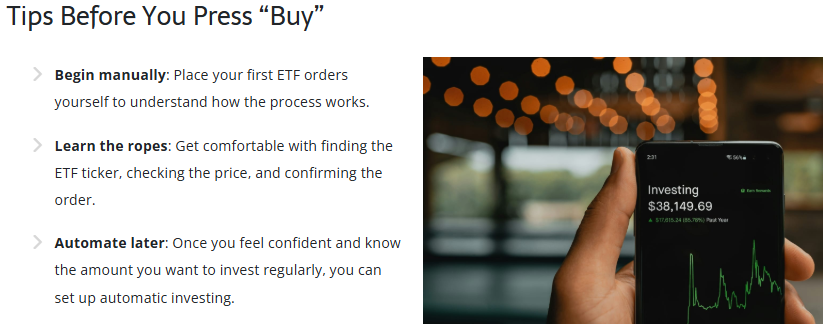
For investors using ETF savings plans, this process can be fully automated. Setting up a monthly direct debit that automatically invests a fixed amount into your chosen ETFs on a set date each month removes the need to think about it, removes the temptation to skip a month when the market looks uncertain, and ensures your investment strategy runs on a system rather than willpower. How to set this up on Trade Republic and Interactive Brokers is covered in the Impact Wealth International brokerage guides.
Principle 5: Diversify Across Regions, Sectors and Asset Classes
Do not put all your eggs in one basket. This is one of the oldest pieces of financial advice in existence and it remains one of the most important precisely because it is so easy to violate in practice.
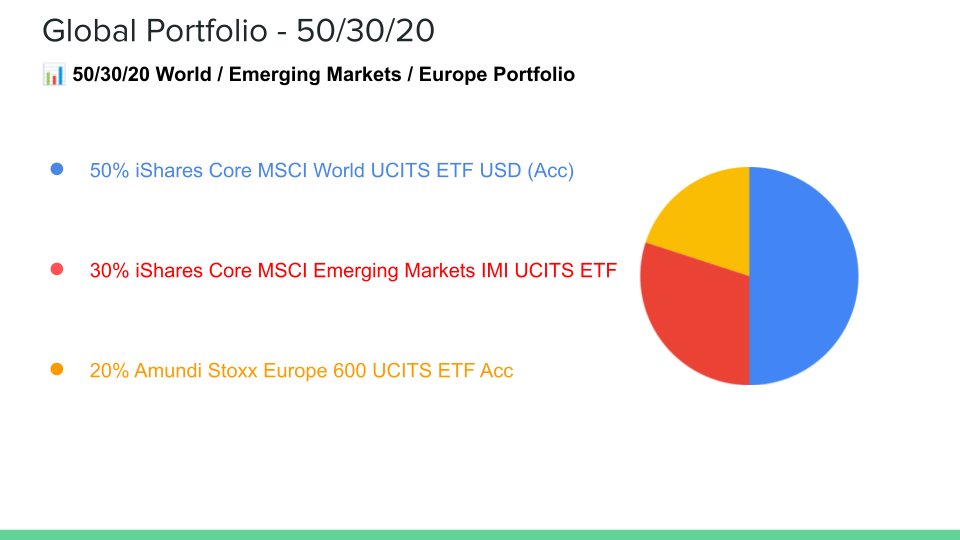
Geographic diversification means spreading your investments across multiple countries and regions so that a crisis in one part of the world does not devastate your entire portfolio. A portfolio invested entirely in US stocks is exposed to the full impact of any US-specific downturn, whether that is a banking crisis, a regulatory change or a currency shift. Adding meaningful exposure to European, Asian and emerging market equities means your portfolio is not dependent on any single economy’s continued prosperity.
Sector diversification means holding companies across multiple industries, including technology, healthcare, financials, consumer goods, energy and industrials, rather than concentrating in a single sector. The dot-com bubble of the late 1990s offers a vivid example of what happens when investor enthusiasm for a single sector outpaces economic reality. Prices inflated to extraordinary levels driven by mass psychology rather than fundamental value, and when the bubble burst, investors concentrated in technology stocks lost enormous amounts. A diversified portfolio across sectors would have experienced a partial decline rather than a catastrophic one.
Asset class diversification across stocks, bonds, real estate and other investment types provides an additional layer of protection because different asset classes tend to respond differently to the same economic events. When equities fall sharply, high-quality bonds often hold their value or rise, cushioning the overall portfolio decline.
ETFs are inherently well-suited to diversification because each fund holds hundreds or thousands of individual company positions. A single broad-market world ETF provides exposure to thousands of companies across dozens of countries and multiple sectors simultaneously. This is one of the most significant advantages ETFs offer over individual stock picking, and it is one of the primary reasons they are the recommended investment vehicle for long-term beginner investors. A full breakdown of how to apply this is covered in the guide to building a diversified ETF portfolio.
Principle 6: Align Your Investments With Your Values
Your money represents your economic agency in the world. Where it is invested determines which companies, industries and practices you are financially supporting, whether you are consciously aware of it or not. A conventional broad-market ETF holds fossil fuel companies, tobacco producers, weapons manufacturers and a wide range of other businesses alongside technology, healthcare and consumer firms.
If some or all of those industries conflict with your values, you have the option to choose investment products that exclude them. Sustainable and ESG-screened ETFs apply filters to their holdings, removing companies involved in fossil fuels, tobacco, weapons, gambling, alcohol and other sectors based on the specific criteria of each fund. This allows you to participate in the long-term growth of global equity markets while directing your capital away from the industries you most want to avoid.
Importantly, choosing sustainable ETFs does not require accepting lower returns as a trade-off for ethical alignment. The evidence on long-term performance of sustainable ETFs relative to conventional equivalents is broadly comparable. Some sustainable funds have outperformed their conventional counterparts over specific periods. The assumption that values-based investing necessarily costs money in returns is not supported by the data.
The sustainable investing universe has also grown dramatically over the past decade, with sustainable fund assets tripling as investor awareness of environmental and social issues has increased. There are now well-established, highly liquid sustainable ETF products covering global developed markets, emerging markets, European equities and Australian equities, providing all the geographic diversification of a conventional portfolio with meaningful ethical screens applied throughout. The Impact Wealth International guide to sustainable ETF types covers these options in detail.
Principle 7: Buy, Hold and Think in Decades Not Days
Passive ETF investing is not a get-rich-quick strategy. It is a get-rich-slowly strategy that has worked consistently for long-term investors across every decade of modern financial market history. The time horizon matters enormously. Over any given week or month, an ETF portfolio might be up, down or flat. Over any given five-year period the picture is considerably more consistent. Over twenty or thirty years the historical record is unambiguous: diversified equity portfolios have consistently grown in value for investors who stayed the course.
The practical implication is that you should not check your portfolio daily. You should not react to short-term market movements. You should not change your investment strategy based on what you read in this week’s financial news. Set up your portfolio, automate your monthly contributions and review it once or twice a year at most. The system does its work whether you are watching it or not, and watching it too closely tends to produce anxiety that leads to poor decisions.
There is also a meaningful tax advantage to long-term holding in many countries. In Australia, capital gains on assets held for more than twelve months attract a 50% discount on the taxable gain. In Belgium, investment gains on assets held for the long term may receive favourable tax treatment compared to short-term speculative gains. Governments in many jurisdictions actively incentivise long-term investing because it channels capital into productive businesses over extended time horizons, which benefits the broader economy. As a long-term investor you benefit from both the compounding of returns and the reduction of your tax burden relative to active traders. Always verify the specific tax rules in your jurisdiction with a qualified adviser before making decisions.
Principle 8: Maintain Emotional Discipline When Markets Fall
Every investor will experience a significant market downturn at some point. Equity markets have declined sharply during every financial crisis in history, and they will do so again. The 2008 global financial crisis saw the S&P 500 fall by approximately 50%. The COVID-19 market shock in early 2020 saw markets drop 30% or more in a matter of weeks. In both cases markets recovered and went on to reach new highs within relatively short timeframes.
The investors who benefited from those recoveries were the ones who stayed invested. The investors who locked in permanent losses were the ones who sold at the bottom, converting a temporary paper decline into a real, irreversible one.
The emotional pull to sell during a crash is genuine and powerful. Watching a portfolio decline in value activates the same loss-aversion mechanisms that drive most short-term financial decision-making. The discipline required to hold through a downturn is not natural. It is a skill that has to be consciously developed, and the most effective way to develop it is to understand the historical pattern before it happens rather than trying to reason your way through it in the middle of a market panic.
Dollar cost averaging helps with this because it removes the decision about whether to invest during a downturn. If your savings plan is automated, it continues investing regardless of market conditions. You are buying more units when prices are lower, which improves your average purchase price and amplifies your recovery when markets rebound.
The system is what protects you from your own emotions. Set up your monthly contributions, define your investment horizon, and commit to not selling based on short-term market movements. Remove the emotion from the process by making as many decisions as possible in advance, before market volatility gives those decisions an emotional charge they should not have.
Principle 9: Why Does Just Starting Matter More Than Getting It Perfect?
None of the principles above matter if the first investment never happens. Waiting for the perfect ETF, the perfect entry price or the perfect amount of saved capital is, for most beginner investors, a reliable way to lose years of potential compounding for no real benefit.
Time in the market is generally a far larger factor in long-term outcomes than the specific ETF chosen or the exact month an investor begins. Someone who starts with a modest, broadly diversified ETF and a small monthly contribution today has decades of compounding ahead of them. By contrast, someone who waits two years for ideal conditions has simply removed two years of growth from the equation, regardless of how the market performs in the meantime.
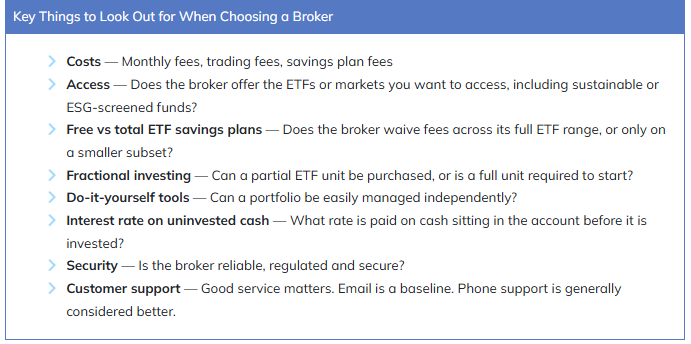
Fractional investing and low minimum contributions on many modern brokers mean that starting no longer requires a large lump sum. A simple, low-cost, broadly diversified ETF, purchased consistently, is a reasonable starting point for most beginners. Refinements such as adding sustainable screens, adjusting regional weightings or introducing bonds can always come later, once the habit of investing regularly is established.
Key Takeaways
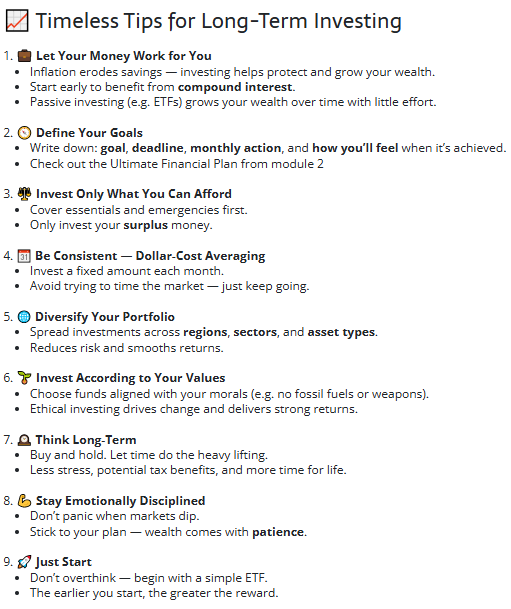
The nine timeless principles covered in this guide apply regardless of which specific ETFs you choose, which broker you use or which market you invest in. Make your money work for you by investing rather than leaving savings idle in a low-interest account. Define specific, written financial goals with target dates and monthly contribution plans. Invest only what you can genuinely afford, building an emergency fund first and committing a monthly amount that is sustainable through good times and bad. Use dollar cost averaging to invest consistently regardless of market conditions, and automate the process so it does not depend on willpower. Diversify across regions, sectors and asset classes so no single market event can significantly damage your overall portfolio. Align your investments with your values by considering sustainable ETF options that exclude the industries you most want to avoid. Hold your investments for the long term and think in decades rather than reacting to daily market movements. And when markets fall, which they will, maintain your emotional discipline, stay invested, and let the system continue working on your behalf. Above all, just start, because time in the market matters more than getting every detail perfect before you begin.
None of these principles are complicated. All of them require consistent application over time. That consistency, more than any specific investment choice, is what determines whether passive ETF investing builds the long-term wealth it is capable of delivering.
Frequently Asked Questions
How long should I plan to hold my ETF investments?
A minimum of five to ten years is generally recommended for equity ETF investments. The longer your time horizon, the more time compound growth has to work and the more market cycles your portfolio passes through, smoothing out any single period of poor performance. Most long-term wealth-building strategies operate on twenty to thirty year horizons.
What is dollar cost averaging and why is it better than investing a lump sum?
Dollar cost averaging means investing a fixed amount on a regular schedule regardless of current market prices. It reduces the risk of committing a large amount just before a significant price decline by spreading purchases across multiple price points over time. For most investors making regular monthly contributions from income, it is the natural approach. For investors with a lump sum, the evidence on whether to invest it all at once or spread it over several months is mixed, but either approach is significantly better than not investing at all.
How much of my income should I actually invest each month?
There is no single percentage that fits everyone, because income, expenses and obligations vary widely. A sensible approach is to build an emergency fund covering several months of essential living expenses first, then invest only the surplus you are comfortable not touching for five, ten or more years. A contribution that feels genuinely sustainable is more likely to continue through a downturn than an ambitious figure based on an idealised projection.
How do I stop myself from panic selling during a market crash?
Automation is the most effective tool. If your monthly contributions are automated and you have no manual trigger required to continue investing, you remove the most dangerous decision point from your investing process. Understanding the historical recovery pattern of diversified ETF portfolios before a crash happens also helps enormously. Every significant market decline in history has been followed by a recovery. Knowing this intellectually before experiencing a downturn is very different from trying to apply it emotionally in the middle of one.
Do I need to check my portfolio regularly?
No. For a passive ETF investor using a buy-and-hold strategy with automated monthly contributions, checking once or twice a year is sufficient. Checking too frequently tends to produce anxiety that leads to poor decisions. The less attention you give your portfolio on a day-to-day basis, the more likely you are to let the long-term compounding process do its work undisturbed.
Are sustainable ETFs a realistic option for a long-term passive portfolio?
Yes. Well-established sustainable ETFs covering global developed markets, emerging markets, European equities and Australian equities are available to investors in all three of the markets covered by Impact Wealth International. They apply meaningful ethical screens, carry competitive management fees and have performance records broadly comparable to their conventional equivalents.
I am a beginner with very little money. Is it worth starting now?
Yes. Time in the market is generally far more important than the size of your first investment or the exact moment you begin. Fractional investing and low minimum contributions on many modern brokers mean you can start with a small monthly amount into a simple, low-cost, broadly diversified ETF. You can always refine your portfolio later. Starting today and letting compounding run for longer usually matters more than waiting for perfect conditions.