Start Manual, Then Automate
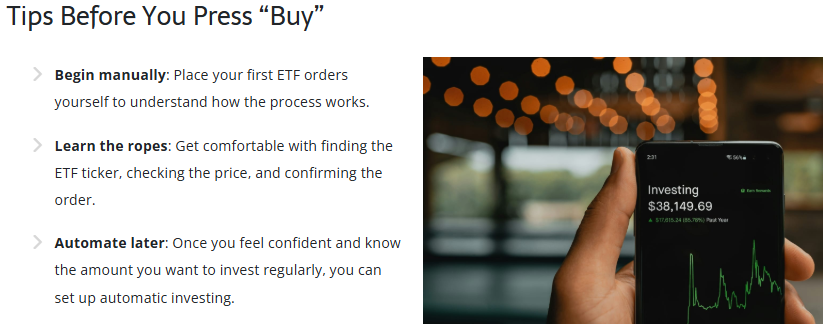
One consideration to make before buying anything is whether to invest manually or set up an automated savings plan. Both are valid long-term approaches, but for a first-time investor, starting manually is the better path.
When you invest manually, you open your brokerage app each month, find the ETF you want to buy, enter the amount and confirm the purchase. It takes a few minutes and gives you hands-on familiarity with how the platform works, what the numbers mean and how your portfolio changes over time. This learning process is valuable and cannot be replicated by simply switching on automation from day one.
Automation, which most platforms support through a recurring savings plan or scheduled purchase, is genuinely powerful once you are comfortable with the process. It removes the friction of logging in each month, eliminates the temptation to skip a contribution when markets look uncertain and ensures your dollar cost averaging strategy runs on a consistent schedule without requiring ongoing effort.
The risk of automating too early is less about the strategy itself and more about the amount. In the early stages of investing, you are still calibrating how much you are comfortable committing each month. If you automate a figure that turns out to be more than you want to invest, you may look at your account a few months later and find more money has been deployed than you planned. Start manually for the first few months, settle on a monthly contribution amount you are genuinely comfortable with, and then automate once that number feels right.
Check the Ticker and Price Before You Buy
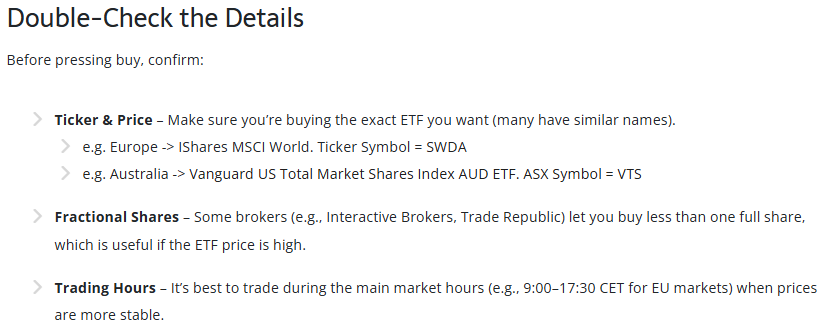
This is one of the most practically important steps and one that first-time investors frequently skip. Before you execute a purchase, confirm that the ETF you are about to buy is actually the fund you researched.
The reason this matters is that multiple ETFs can have very similar names without being the same product. There are dozens of S&P 500 ETFs, for example, tracking the same index but issued by different providers, domiciled in different countries, denominated in different currencies and carrying different expense ratios. Buying the wrong one is a real and surprisingly common mistake.
The simplest way to verify you have the right fund is to check two things: the current price and the ticker symbol.
The price check works because different ETFs trade at very different unit prices. If you researched an iShares Core S&P 500 ETF trading at approximately $512 per unit on justETF and the product showing up in your broker app is priced at $20, you are almost certainly looking at a different fund. The prices do not need to match to the cent since ETF prices fluctuate throughout the trading day, but they should be in the same ballpark. A significant price discrepancy is an immediate signal to investigate further before buying.
The ticker check is even more reliable. Every ETF has a unique ticker symbol that identifies it precisely on a specific exchange. The same ETF may trade on multiple exchanges under different tickers, for example CSP1 on the London Stock Exchange or CSPX on Euronext, but within a given exchange the ticker is unique. If the ticker showing in your brokerage app matches the one you noted from your research on justETF, the ASX website or ETF Database, you are buying the correct fund. Research platforms including justETF display all available tickers for each ETF by exchange, making it easy to confirm before committing.
Understand Fractional Shares
Many ETFs trade at unit prices of several hundred dollars or euros. If your monthly contribution budget is $100 to $200, you might wonder how to invest in a fund priced at $500 per unit. The answer is fractional shares.
Fractional share investing means you can buy a proportion of one ETF unit rather than needing to purchase a whole unit. If an ETF trades at $500 per unit and you want to invest $100, fractional investing lets you buy 0.2 of a unit. Your $100 is invested immediately and you receive the proportional returns of your fractional position.
Both Trade Republic and Interactive Brokers support fractional share investing, which means there is effectively no minimum investment amount beyond whatever small minimum the platform itself sets, typically a few euros or dollars. This removes one of the most common practical barriers for beginner investors who want to build a diversified multi-ETF portfolio without needing hundreds of dollars per fund per month.
If you are using a different broker, check whether fractional investing is supported before assuming you can invest any amount freely. Some platforms still require whole-unit purchases, which can make regular small contributions difficult if your chosen ETFs trade at high unit prices.
Know Your Trading Hours
ETFs trade on stock exchanges during defined market hours, and the timing of your purchase can have a small effect on the price you receive.
For EU markets the standard trading window is approximately 9:00 to 17:30 CET. Australian investors trading on the ASX have market hours of 10:00 to 16:00 AEST. US investors trading on NYSE or Nasdaq have hours of 9:30 to 16:00 ET. Orders placed outside these windows are generally queued and executed at the market open on the next trading day.
The practical consideration is that price volatility tends to be higher at the very beginning and end of trading sessions, as market participants adjust positions and react to overnight news. For broad-market ETFs this volatility is considerably less pronounced than for individual stocks because the sheer number of underlying holdings absorbs and spreads any single piece of news. The price movement of a fund holding 1,500 companies during an opening spike is far smaller than that of an individual stock.
For most beginner investors doing regular monthly contributions, the precise timing of your purchase within the trading day matters very little over a long time horizon. The price difference between buying at 9:05 and buying at 14:00 on the same day is negligible compared to the effect of consistent contributions over years. The main thing to avoid is placing large orders immediately at market open or during the final minutes before close, when short-term volatility is at its peak.
Market Orders vs Limit Orders: Which to Use
When you execute a purchase in your brokerage app, you will typically be asked to choose between a market order and a limit order. Understanding the difference is important for beginners.
A market order executes immediately at the best available current price. You enter the amount you want to invest, confirm the order and it fills at whatever the market price is at that moment. For passive ETF investors making regular monthly contributions, a market order is almost always the right choice. You are not trying to time the market or buy at a specific price point. You are simply deploying your monthly contribution at the current price and holding for the long term.
A limit order allows you to specify the maximum price you are willing to pay. The order only executes if the market price falls to or below your specified limit. If the market never reaches your limit price, the order does not fill and your money remains uninvested. Limit orders are more commonly used by active traders who want precise control over their entry price.
For a passive ETF investor the limit order approach introduces a counterproductive friction. The whole point of dollar cost averaging is to invest consistently regardless of whether the price is high, low or sideways. Placing a limit order and waiting for a specific price before buying is a subtle form of market timing, and as the research on active investing consistently shows, the vast majority of market timing attempts produce worse outcomes than simply buying at the current price and holding.
Start with market orders. They are simpler, execute immediately and align perfectly with a passive long-term investment strategy.
Should You Set a Stop-Loss Order on an ETF?
A stop-loss order is an automatic instruction that sells your position if the price drops below a specified threshold, for example 20% below your purchase price. Stop-loss orders are commonly used by active investors managing individual stock positions to limit their downside if a specific company underperforms badly.
For broad-market ETF portfolios, stop-loss orders are generally not recommended, and the reason is central to understanding why ETF investing works differently from stock picking.
When you own a diversified ETF tracking 1,500 global companies, a 20% drop in the fund’s value means the global equity market has declined by approximately that amount. This is a market-wide event, not a fund-specific one. Historical market data shows that broad-market declines of this magnitude are temporary. The S&P 500 fell approximately 50% during the 2008 global financial crisis and recovered to new all-time highs within several years. A stop-loss triggered at a 20% decline would have sold the ETF near the bottom, converting a temporary paper loss into a permanent realised loss and locking out the subsequent recovery.
Stop-loss orders also interact poorly with the dollar cost averaging strategy that underlies passive ETF investing. The value of a declining market for a long-term investor making regular contributions is that each monthly purchase buys more units at a lower price. A stop-loss order interrupts this process by triggering a sell at exactly the moment when buying more would be most advantageous.
This does not mean stop-loss orders are never useful. For active investors managing individual stock positions where permanent impairment of a company is a genuine risk, a stop-loss can be an important risk management tool. For broad-market ETF investors with a long time horizon, staying invested through downturns, continuing regular contributions and avoiding emotionally driven selling are the behaviours that produce strong long-term returns.
How Often Should You Check Your Portfolio?
The natural instinct when you start investing is to check your portfolio frequently. At the beginning this can feel educational and engaging, watching the numbers move and understanding how markets behave in real time. Over time, however, daily portfolio checking becomes a source of unnecessary noise and, for many investors, a trigger for poor decisions.
A portfolio that drops by half a percent on a Tuesday is not meaningful information for a long-term investor. It says nothing about whether the fund is performing well relative to its long-term trajectory and nothing about whether any action is required. The short-term day-to-day movements of a diversified ETF portfolio are essentially random within the context of a twenty-year wealth-building strategy.
A sensible routine for most passive ETF investors is to check the portfolio once a month when making a contribution, and to conduct a more deliberate review once or twice a year to confirm the allocation is still appropriate and no significant changes to the funds are warranted. This is genuinely all that is required to manage a well-constructed passive ETF portfolio. The set-and-forget nature of passive investing is a feature, not a limitation, and the less emotional engagement your investing strategy requires, the more effectively it tends to work.
Key Takeaways
Buying your first ETF correctly comes down to a small number of practical steps applied consistently. Start manually to learn the process before automating, and only automate once you are confident in the monthly contribution amount you want to commit. Always verify the ETF you are purchasing by checking both the unit price and the ticker symbol before confirming any transaction. Use fractional shares to invest your exact monthly budget regardless of the ETF’s unit price. Trade during market hours to avoid unnecessary price volatility. Use market orders for regular monthly contributions rather than limit orders. Avoid stop-loss orders on broad-market ETF positions because they risk triggering a sale at the worst possible time during a temporary market decline. And check your portfolio monthly at contribution time rather than daily, trusting the long-term strategy rather than reacting to short-term noise.
These are not complex principles. Applied consistently, they protect you from the most common practical mistakes that erode returns for beginner investors, leaving the long-term compounding process to do the work it is designed to do.
Frequently Asked Questions
How do I find the correct ETF in my brokerage app?
Search by the fund’s full name or ISIN number, which is a unique twelve-character identifier for every financial instrument. The ISIN is listed on justETF, ETF Database and the ASX website for every ETF. Using the ISIN to search removes any ambiguity about which fund you are buying.
What is a ticker symbol and where do I find it?
A ticker is a short alphabetic code that uniquely identifies a security on a specific exchange. Examples include CSPX for the iShares Core S&P 500 UCITS ETF on Euronext, CSP1 for the same fund on the London Stock Exchange, and VDHG for the Vanguard Diversified High Growth ETF on the ASX. justETF lists all tickers by exchange for European ETFs. The ASX website lists all tickers for Australian ETFs.
Do I have to buy a whole ETF unit?
No, if your broker supports fractional shares. Both Trade Republic and Interactive Brokers support fractional investing, allowing you to invest any amount regardless of the ETF’s unit price. Check whether your specific broker supports fractional shares before assuming this is available.
What happens if I place an order outside trading hours?
Most brokers will queue the order and execute it at the market open on the next trading day. The price you receive will be the opening price at market open rather than the price shown when you placed the order the previous evening. For long-term investors making monthly contributions this difference is typically negligible.
Is a market order always the right choice?
For passive ETF investors making regular contributions, yes. A market order executes immediately at the current price, which is exactly what a dollar cost averaging strategy requires. Limit orders are more appropriate for active investors seeking precise entry points on individual securities.
What is the difference between a savings plan and a manual purchase?
A savings plan, also called an automated investment plan, instructs your broker to invest a fixed amount into a specified ETF on a regular schedule, typically monthly, without any manual action required from you. A manual purchase requires you to log in and place the order yourself each time. Both achieve the same result. The savings plan removes friction and ensures consistency. Manual investing is better for beginners learning the process.