What Is a Brokerage Account?
Money is deposited into the account, and those funds are then used to invest in financial markets through the broker’s platform. The account holds the resulting portfolio and tracks its value over time. When an investor wants to sell, the same platform handles the transaction and the proceeds return to the account balance.
Brokers vary significantly in which markets they provide access to, what products they offer, what they charge in fees and how easy their platform is to use. Some are designed for experienced active traders. Others are built specifically for beginners who want a simple, low-cost way to invest regularly in ETFs.
One reassurance worth noting: there is not much that can go wrong when choosing between established, regulated brokers. Larger platforms are required to be regulated by financial authorities in the countries where they operate, and client funds are typically held separately from the broker’s own funds. The decision is about finding the best fit, not about avoiding a dangerous choice.
For context on what these accounts are actually used to buy, the guide on what an ETF is and how it works is a useful starting point before comparing brokers.
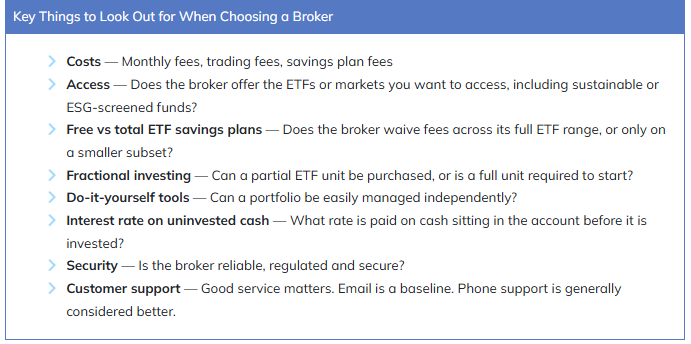
Key Things to Look for When Choosing a Broker
Fees and order costs. This covers everything charged for using the platform: a monthly account fee if one applies, the cost charged each time a trade executes, and any fee for setting up an automated ETF savings plan. Investing in three ETFs monthly at $5 per trade means $15 a month, or $180 a year, purely in transaction costs. Some brokers charge as little as $1 per trade or offer commission-free trading on specific products entirely. Small differences here compound meaningfully over a long investing horizon.
Number of free vs total ETF savings plans. Many European and some US and Australian brokers list a large total number of ETFs but only offer a fee-free automated savings plan on a smaller subset of them. A broker advertising “2,500 ETFs” might only allow free recurring monthly investment into a few hundred of those. Checking the free-vs-total split for ETF savings plans specifically, not just the total ETF count, avoids an unwelcome surprise after an automated plan is already set up on a fund that turns out to carry an execution fee.
Whether fractional ETF investing is supported. This affects how much money is needed to get started, and is covered in more detail in the next section.
Market access. Some brokers are restricted to products listed on a single domestic exchange. Others provide access to dozens of international markets. Broader market access tends to matter most for investors planning to hold a mix of domestic and globally diversified ETFs in one account, rather than splitting holdings across multiple brokers.
Interest rate on uninvested cash. Most brokers pay some interest on cash sitting in the account before it is invested. Rates vary considerably between platforms and change over time as central bank rates shift, so checking the current rate directly on the broker’s website rather than relying on outdated comparisons is worthwhile.
Customer service experience. Independently published reviews and broker comparison sites generally cover this in more depth than a broker’s own marketing pages. Checking for patterns in complaints, such as slow withdrawal processing or unresponsive support during account verification, is a more reliable signal than star ratings alone.
Security and regulation. Established, regulated brokers that have operated for several years and are overseen by recognised financial regulators are generally considered a sound starting point. In Europe, this means regulation by BaFin, the FCA or an equivalent national authority. In Australia, this means ASIC regulation. In the US, this means SEC registration and FINRA membership, with confirmation that the broker is a SIPC member, which protects client accounts up to $500,000 in the event of broker failure, as explained on the Securities Investor Protection Corporation’s official site.
What Is Fractional ETF Investing?
Fractional ETF investing allows the purchase of a partial unit of an ETF rather than a full share. If a single unit of an ETF costs $400 and only $50 is available to invest, a fractional-share broker allows that $50 to buy one-eighth of a unit, rather than requiring the full $400 upfront.
This matters most for beginners with limited starting capital. Without fractional investing, building a diversified portfolio across several ETFs can require thousands of dollars simply to hold one full unit of each fund. With fractional investing, a small monthly contribution can be spread across multiple ETFs from the very first deposit, which supports automated, consistent investing regardless of account size.
Not every broker offers this feature, and the ETFs eligible for fractional purchase are not always the same as the broker’s full ETF range. Fidelity and Vanguard, for example, both support fractional-share ETF investing in the US starting from as little as $1, while Charles Schwab does not currently offer fractional-share ETFs. Availability also varies by region and changes over time, so checking a broker’s current fractional investing policy directly, rather than assuming it applies across all listed ETFs, is worthwhile before committing to a platform on this basis alone.
Why ETF Selection Matters for Sustainable Investing
This point deserves its own section because it is easy to overlook. A broker’s total ETF count is not just a convenience metric. It directly affects whether values-aligned investing is realistically possible on that platform.
Sustainable, ESG and SRI ETFs represent a smaller subset of the total ETF universe compared with broad-market or sector funds. A broker offering tens of thousands of instruments across many markets is statistically more likely to carry a meaningful range of ESG-screened funds than a broker offering a few hundred domestically listed products. The reverse also holds: a platform with a narrow product range may carry only one or two token ESG ETFs, or none at all, leaving little real choice for an investor trying to build a values-aligned portfolio.
Checking a broker’s ETF screener for ESG, SRI or sustainable filters before opening an account is a practical way to confirm whether genuine choice exists, rather than discovering the gap after funds have already been deposited. The article on how to check if an ETF is actually sustainable covers what to look for once a shortlist of available funds has been identified.
How Does Location Affect Your Brokerage Options?
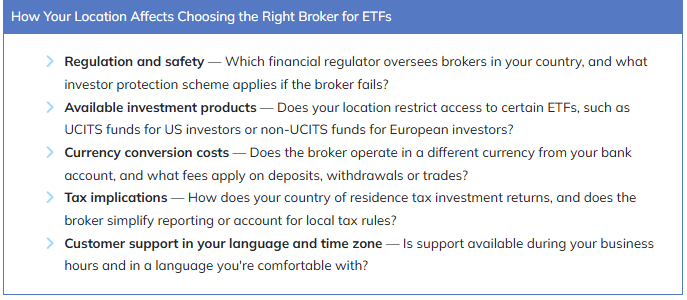
Location is one of the most important factors in determining which brokers are available. There are five key ways location shapes brokerage options.
Regulation and safety. Every country has its own financial regulatory framework. A broker approved and regulated in an investor’s country of residence is subject to local consumer protection rules, which keeps funds safer and provides legal recourse if something goes wrong. In the US, accounts at SEC-registered, FINRA-member, SIPC-member brokers carry $500,000 in protection per account. In Europe, national investor compensation schemes typically protect up to €20,000 or more. In Australia, ASIC regulation and the Australian Financial Services licence framework provide the relevant protections.
Available investment products. Some brokers are restricted to products listed on their domestic exchange. Others provide access to global markets. As covered above, confirming that a broker offers access to specific desired funds, including sustainable options and fractional investing, before opening an account is a sensible first step. US investors face a particular distinction: the UCITS ETFs widely used in Europe are generally not available for purchase by US investors due to differences in securities regulation. The European Commission’s own summary of the UCITS framework explains the directive’s purpose of offering investors a wider product choice at lower cost across EU member states. US investors typically use domestically domiciled ETFs listed on US exchanges such as NYSE Arca or Nasdaq instead.
Currency conversion costs. If a broker operates in a different currency from the linked bank account, a currency conversion fee may apply on every deposit, withdrawal or trade. These costs are easy to overlook but can erode returns meaningfully over time.
Tax implications. Country of residence determines how investment returns are taxed. Belgian investors need to be aware of the Transaction Tax (TOB) and Reynders tax. Australian investors need to consider capital gains tax treatment. US investors using tax-advantaged accounts such as an IRA or Roth IRA benefit from significant tax advantages that make account type selection as important as broker selection. This is general educational context only and does not constitute tax advice. A qualified tax adviser in the relevant jurisdiction should be consulted for guidance specific to individual circumstances.
Customer support in your language and time zone. Regional support means assistance is available in the relevant language, during local business hours and with an understanding of local regulations.
Regional Differences: Europe, Australia and the US
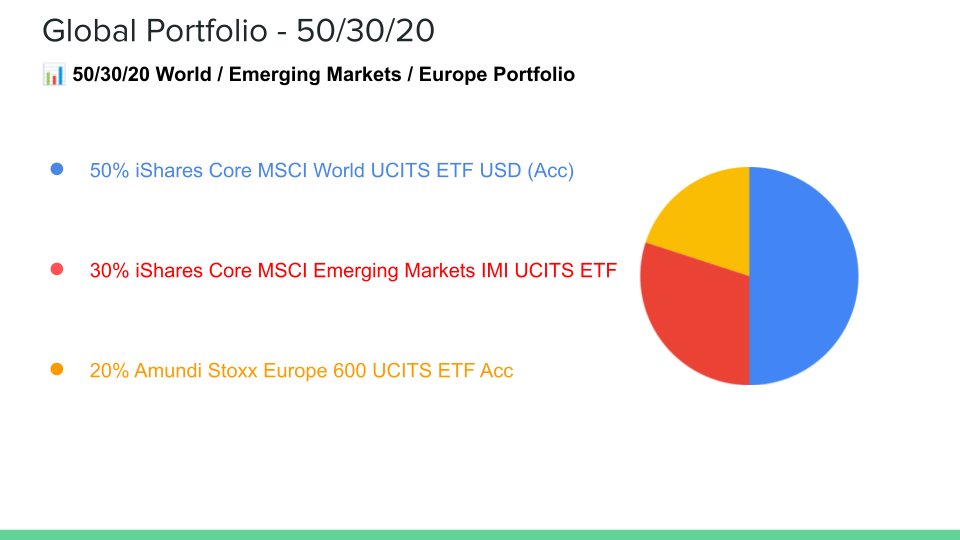
European investors. European retail investors typically access ETFs listed on multiple exchanges including Euronext in Amsterdam and Paris, Xetra in Frankfurt and the London Stock Exchange. ETFs available for retail purchase must be UCITS-compliant, a regulatory standard for retail investment products in the European Union. Most globally diversified ETFs from major providers including iShares, Vanguard and Amundi are available in UCITS format. European investors can research ETF options at justETF, a comprehensive free ETF research tool for UCITS products.
Australian investors. Australian investors access ETFs primarily through the Australian Securities Exchange (ASX), which hosts a well-developed and growing range of ETF products. Australian brokers are regulated by ASIC, and ETF products are governed by a Product Disclosure Statement that investors can access before purchasing. The Moneysmart guide to ETFs, published by Australia’s independent financial regulator ASIC, provides further detail on what to check before buying.
US investors. US investors have access to one of the largest and most competitive brokerage markets in the world, with many major platforms offering commission-free trading on ETFs and several supporting fractional-share investing. US investors cannot purchase UCITS ETFs but have domestically listed equivalents from Vanguard, iShares and Schwab at very low expense ratios. A consideration specific to US investors is account type. A standard taxable brokerage account is the most straightforward starting point, but tax-advantaged accounts such as a Traditional or Roth IRA offer long-term benefits worth researching separately. Contribution limits and account rules change periodically, so checking the IRS website for current figures is recommended. This is general educational context only and does not constitute tax advice.
Brokers Worth Considering by Region
The brokers below are mentioned for informational purposes only. This does not constitute a recommendation of any specific product. Fees, market access and product ranges change regularly, so confirming current details directly on each provider’s website before opening an account is recommended.
Europe
Trade Republic
Available to investors with a bank account in a SEPA-compatible EU member state.
- Fees and order costs: no monthly account fee; a flat order fee of around €1 per trade
- Free vs total ETF savings plans: supports automated ETF savings plans with no execution fee across its listed ETF range
- Fractional investing: supports fractional-share purchases on its ETF savings plans, allowing contributions of just a few euros per month
- Market access: lists over 2,600 investment products, primarily focused on European and US markets
- Customer service: support is handled in-app, with reviewers generally noting fast digital onboarding but limited phone support
- Interest rate: pays interest on uninvested cash, with the rate adjusted periodically in line with European Central Bank rates
Open an account at Trade Republic.*
Interactive Brokers
One of the most established global brokers, available across the Eurozone, UK, Switzerland and many other countries.
- Fees and order costs: low per-trade commissions that vary by exchange and order size
- Free vs total ETF savings plans: offers a recurring investment feature, though the proportion of ETFs eligible for fee-free automated investing varies by region and should be checked directly
- Fractional investing: supports fractional shares on a range of stocks and ETFs, depending on the account type and region
- Market access: an exceptionally wide range of ETFs and access to markets globally, which, in line with the point made earlier in this article, also tends to support a broader range of sustainable and ESG-screened ETFs than smaller platforms
- Customer service: generally well regarded for account security and multi-market support, though the platform interface has a steeper learning curve for complete beginners
- Interest rate: pays tiered interest on uninvested cash depending on account balance
Open an account at Interactive Brokers.*
Australia
CMC Invest
- Fees and order costs: $0 brokerage on the first $1,000 traded per ASX security each day, and $0 brokerage on US, UK, Canadian and Japanese-listed securities; additional ASX trades incur a small fee
- Free vs total ETF savings plans: access to over 40,000 stocks and ETFs across the ASX and 15 global markets, giving a wide pool to select from for any automated investing feature
- Fractional investing: not a core feature of the platform; trades are generally for whole units within the relevant daily brokerage-free threshold
- Market access: one of the broadest market ranges among Australian brokers, spanning 16 markets
- Customer service: generally well rated in independent broker comparisons, with strong screening and research tools cited as a strength
- Interest rate: pays interest on cash held in the linked account, with current rates published on the provider’s site
This breadth of ETF access is one reason CMC has remained popular with Australian investors, since a larger product range generally means more sustainable and ESG-screened fund options are available to choose from.
Pearler
- Fees and order costs: flat-fee structure aimed at long-term, infrequent traders rather than active trading
- Free vs total ETF savings plans: built specifically around automated recurring investing, with its product positioned for “set and forget” contributions
- Fractional investing: does not currently offer fractional ETF investing; recurring contributions accumulate until a whole unit can be purchased
- Market access: ASX-focused, with a narrower international range than CMC Invest or Interactive Brokers
- Customer service: known for a community-driven, education-first approach to long-term investing rather than active trading support
- Interest rate: pays interest on uninvested cash, current rate published on the provider’s site
CommSec
- Fees and order costs: tiered brokerage based on trade value, generally higher than newer low-cost platforms
- Free vs total ETF savings plans: offers CommSec Pocket as a simplified, lower-cost option for ETF investing with a more limited fund range than the full CommSec platform
- Fractional investing: CommSec Pocket allows smaller dollar-based investment amounts into a limited ETF range, though this differs from true fractional-share ownership on the main platform
- Market access: backed by the Commonwealth Bank’s long-standing market presence, with broad ASX coverage and international access
- Customer service: benefits from CommSec’s decades of operating history and integration with Commonwealth Bank’s broader customer service infrastructure
- Interest rate: pays interest on cash holdings, rate published on the provider’s site
Selfwealth
- Fees and order costs: flat-fee trading regardless of trade size, which can suit investors making larger, less frequent contributions
- Free vs total ETF savings plans: offers access to ASX and US markets, with automated investing features that vary depending on account tier
- Fractional investing: not a standard feature; trades are generally for whole units
- Market access: ASX and US markets, narrower than CMC Invest’s 16-market range
- Customer service: now part of Syfe following a corporate transition, with reviewers noting the integration is still maturing
- Interest rate: pays interest on cash balances, current rate published on the provider’s site
United States
Fidelity
- Fees and order costs: $0 commission for stock and ETF trades, $0.65 per options contract
- Free vs total ETF savings plans: supports automatic investment features across a broad range of its 2,500-plus available ETFs, with fractional-share investing from $1
- Fractional investing: supports fractional-share ETFs starting from $1, one of the more accessible entry points among major US brokers
- Market access: access to 25 international exchanges alongside the US market
- Customer service: consistently rated among the strongest in the US brokerage industry for research tools and support quality
- Interest rate: competitive rate on uninvested cash compared with other major US brokers
Charles Schwab
- Fees and order costs: $0 for stock and ETF trades, $0.65 per options contract
- Free vs total ETF savings plans: automatic investing features available, paired with extensive ETF screening tools through its thinkorswim platform
- Fractional investing: does not currently offer fractional-share ETFs, a noted limitation compared with Fidelity and Vanguard
- Market access: strong domestic market coverage
- Customer service: rated highly for platform usability, combining a straightforward web experience with the more advanced thinkorswim suite
- Interest rate: pays close to nothing on uninvested cash, a frequently cited drawback in independent reviews
Vanguard
- Fees and order costs: $0 for stock and ETF trades, $0 plus $1 per options contract
- Free vs total ETF savings plans: supports recurring investment specifically into Vanguard’s own ETF range, which sits at just over 100 funds, comparatively narrow given the point made earlier in this article about ETF breadth and sustainable fund access
- Fractional investing: supports fractional Vanguard ETF shares starting from $1, though this does not extend to individual stocks
- Market access: focused primarily on Vanguard’s own fund range rather than broad third-party market access
- Customer service: generally well regarded for long-term, buy-and-hold investors rather than active traders
- Interest rate: pays a comparatively high interest rate on uninvested cash relative to other major US brokers
How Do You Open a Brokerage Account in Five Steps?
Step 1: Compare providers and choose one. The criteria above help identify the broker that best suits location, desired products including sustainable ETF range and fractional investing support, and fee structure. European investors can use justETF’s broker comparison. US investors can use comparison tools from NerdWallet or BrokerChooser.
Step 2: Register online. Personal information required typically includes full name, date of birth, address and reference bank account details. US investors opening an IRA or Roth IRA will also need to confirm tax filing status and annual income.
Step 3: Complete the investing knowledge questionnaire. Most regulated brokers are required to assess investing experience before granting full account access. This is a standard regulatory requirement, not a test that can be failed.
Step 4: Verify identity. Identity verification is required by anti-money laundering regulations in all three markets, typically handled through a photo ID upload combined with a selfie or short video call.
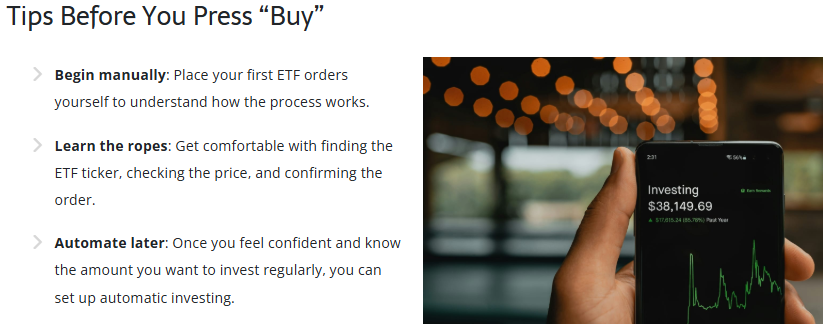
Step 5: Deposit funds and start investing. Once verified, funds can be transferred from a bank account, after which individual orders can be placed or an automated regular investment plan set up. For building a financial plan around automated investing, setting up a recurring contribution at this stage removes ongoing friction later.
Key Takeaways
A brokerage account is a straightforward, accessible tool that most investors can open in under 30 minutes. The key factors worth comparing are fees and order costs, the proportion of ETFs eligible for free automated savings plans, whether fractional ETF investing is supported, market access, customer service quality and the interest rate paid on uninvested cash. A broker’s total ETF count also matters beyond convenience, since platforms with a broader product range tend to offer more sustainable, ESG and SRI fund choices.
Fractional investing in particular can lower the barrier to entry significantly, since it allows a portfolio to be built across several ETFs from the very first small deposit rather than requiring the full price of one unit at a time. European investors within SEPA-compatible EU member states have several low-cost options to research, including Trade Republic. Australian investors are well served by ASX-focused brokers such as CMC Invest, Pearler, CommSec and Selfwealth, alongside global platforms like Interactive Brokers. US investors have one of the most competitive brokerage landscapes in the world, with Fidelity and Vanguard both offering accessible fractional-share entry points. Once an account is open, setting up an automated monthly ETF contribution removes ongoing friction regardless of market conditions.
Frequently Asked Questions
Is my money safe in a brokerage account?
With established, regulated brokers, client funds are generally held separately from the broker’s operational funds. In the US, SIPC protects client accounts up to $500,000. In Europe, national investor compensation schemes typically cover up to €20,000 or more. In Australia, ASIC regulation provides the relevant framework.
What is the difference between a taxable brokerage account and an IRA for US investors?
A taxable brokerage account has no contribution limits and no restrictions on withdrawals, but gains are generally subject to capital gains tax each year. A Traditional or Roth IRA offers tax advantages under current rules but carries annual contribution limits. Tax treatment varies by individual circumstances. This is educational context only and does not constitute tax advice.
Can an investor have more than one brokerage account?
Yes. Some investors use multiple brokers, for example one for domestic ETFs and another for international or sustainable fund access not available on their primary platform.
What is fractional ETF investing, and why does it matter for beginners?
Fractional ETF investing allows the purchase of a partial unit of an ETF rather than a full share, so a small amount of money can still go toward an expensive ETF rather than needing to save up for a full unit first. Not all brokers offer this, and availability can vary by ETF even on platforms that do support it.
How much money is needed to open a brokerage account?
Most modern brokers have no minimum deposit requirement, or a very low one. On platforms that support fractional ETF investing, starting with as little as $1 to $25 is often possible.
What is an ETF savings plan, and why does the free-vs-total split matter?
An ETF savings plan is an automated instruction that directs a broker to invest a fixed amount into one or more ETFs on a regular schedule. Some brokers only waive the execution fee on a limited subset of their total ETF range, so checking which specific funds qualify for fee-free automated investing avoids an unexpected cost once a plan is already running.
Does a low ETF count on a broker matter if only a global index fund is wanted initially?
It can still matter. Even investors focused on a single broad-market ETF may later want to add a sustainable, regional or thematic fund. Checking a broker’s full ETF range before committing avoids the inconvenience of switching platforms later.
Is speaking to a financial adviser necessary before opening a brokerage account?
It is not required, but for anyone uncertain about investment goals, risk tolerance or tax situation, speaking with a qualified financial adviser in their country of residence is a sensible step before committing significant funds.