Why Isn’t the Sustainable ETF Label Enough?
The sustainable investing market has grown dramatically over the past decade, and with that growth has come an expansion of funds carrying ESG, sustainable, ethical or responsible labels. The challenge is that these labels are not standardised. A fund called ESG does not automatically exclude fossil fuels. A fund called sustainable may still hold tobacco producers, conventional weapons manufacturers or companies with serious ongoing controversy scores.
This matters because greenwashing, the practice of applying a sustainability label to a fund whose holdings do not meaningfully reflect sustainability principles, is a documented issue in the retail ETF market. Without understanding the specific methodology a fund applies, there is no reliable way to know whether invested money is going where intended. A full breakdown of how to check for this directly is covered in the Impact Wealth International guide to spotting greenwashing.
The practical solution is understanding two things: first, whether a fund is built on exclusion or on theme, and second, if it is exclusionary, how deep those exclusions actually go.
Thematic vs Exclusionary ETFs: What’s the Difference?
Sustainable ETFs generally fall into one of two broad construction approaches, and understanding which type a fund uses is often more revealing than the label alone.
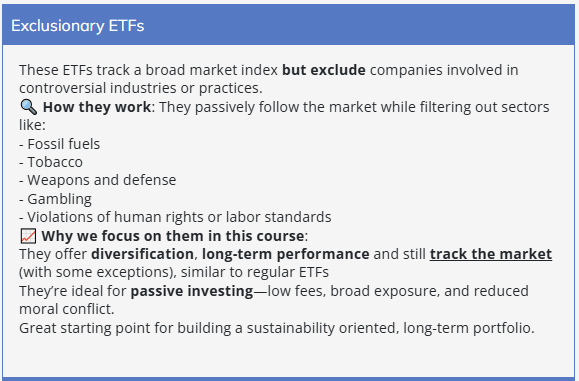
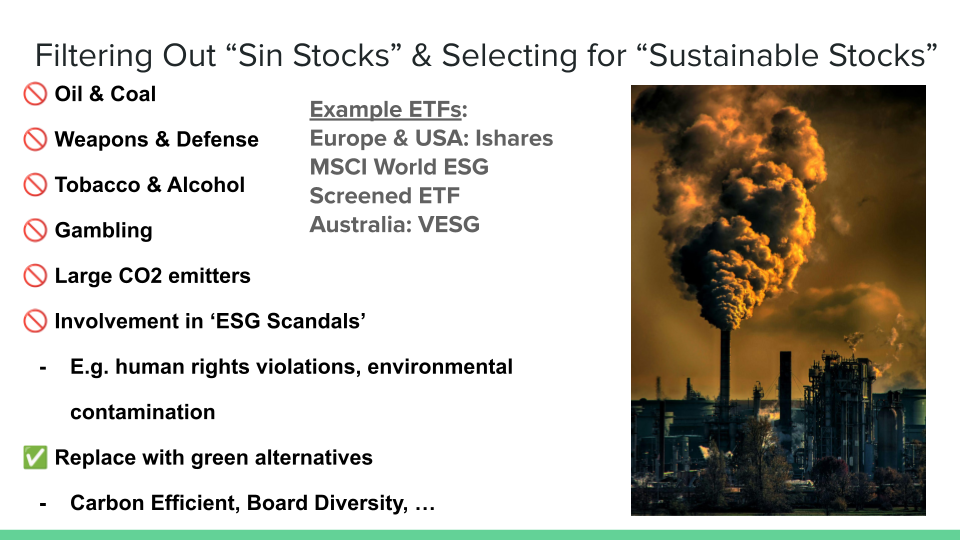
Exclusionary ETFs start from a broad, conventional index, such as the MSCI World or a regional equivalent, and then remove companies that fail to meet specific criteria, such as fossil fuel involvement, weapons manufacturing or tobacco production. The remaining companies span the same wide range of industries as the original index, just with the most problematic names removed. This is the approach used by the MSCI ESG Screened, ESG Enhanced and SRI tiers covered later in this guide, and it tends to produce a fund that still looks broadly diversified across sectors, just narrower than the unscreened version.
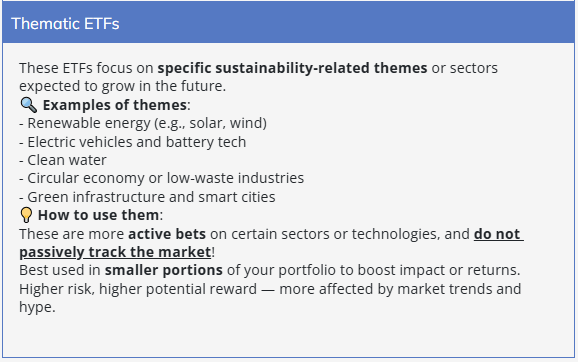
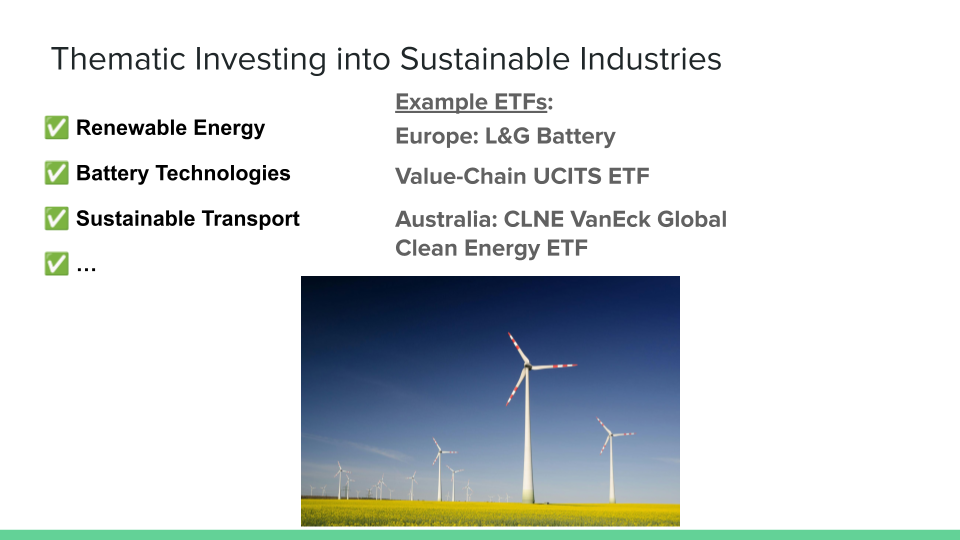
Thematic ETFs work the opposite way. Rather than starting broad and excluding, they start narrow and select. A thematic fund builds its entire portfolio around a specific sustainability theme, such as renewable energy, clean water, electric vehicles or the circular economy, actively choosing companies whose core business operates within that theme. A clean energy thematic ETF, for example, might hold solar panel manufacturers, wind turbine producers and battery technology companies, and effectively nothing else. Some background information can be found here as well.
The practical difference for an investor is significant. An exclusionary fund offers diversification similar to a conventional index fund, since it still holds companies across many sectors and countries, just with specific exclusions applied. A thematic fund offers concentrated exposure to a single trend, which means higher potential upside if that theme performs well, but also meaningfully higher risk, since the fund’s fortunes are tied to one narrow slice of the economy rather than spread across it. A downturn specific to that theme, such as a fall in clean energy stocks during a period of rising interest rates, affects a thematic fund far more than it would affect a broadly diversified exclusionary fund.
Many sustainable investors use these two approaches together rather than choosing one exclusively, holding a broad exclusionary fund as a core portfolio position and adding a smaller thematic allocation for a specific sustainability outcome they want to support more directly. This does not constitute a recommendation of any specific approach, and individual circumstances and risk tolerance vary considerably.
MSCI ESG Index Types: An Overview
MSCI is one of the world’s largest index providers. Its ESG index family offers three main tiers of sustainable indexing, each starting from the same broad parent index, such as the MSCI World Index or the MSCI Emerging Markets Index, and then applying progressively stricter exclusion criteria.
Three common types are the MSCI ESG Screened index, the MSCI ESG Enhanced index and the MSCI SRI index. Each removes companies that do not meet its criteria, but they differ significantly in how many companies they remove and what criteria they apply. Understanding the hierarchy from lightest to strictest is the foundation for choosing the right sustainable ETF for your portfolio.
MSCI ESG Screened: The Baseline
The MSCI ESG Screened index is the most basic tier of the MSCI sustainable index family. It is designed to remove the most obvious problematic companies from a broad market index while still maintaining broad market diversification.
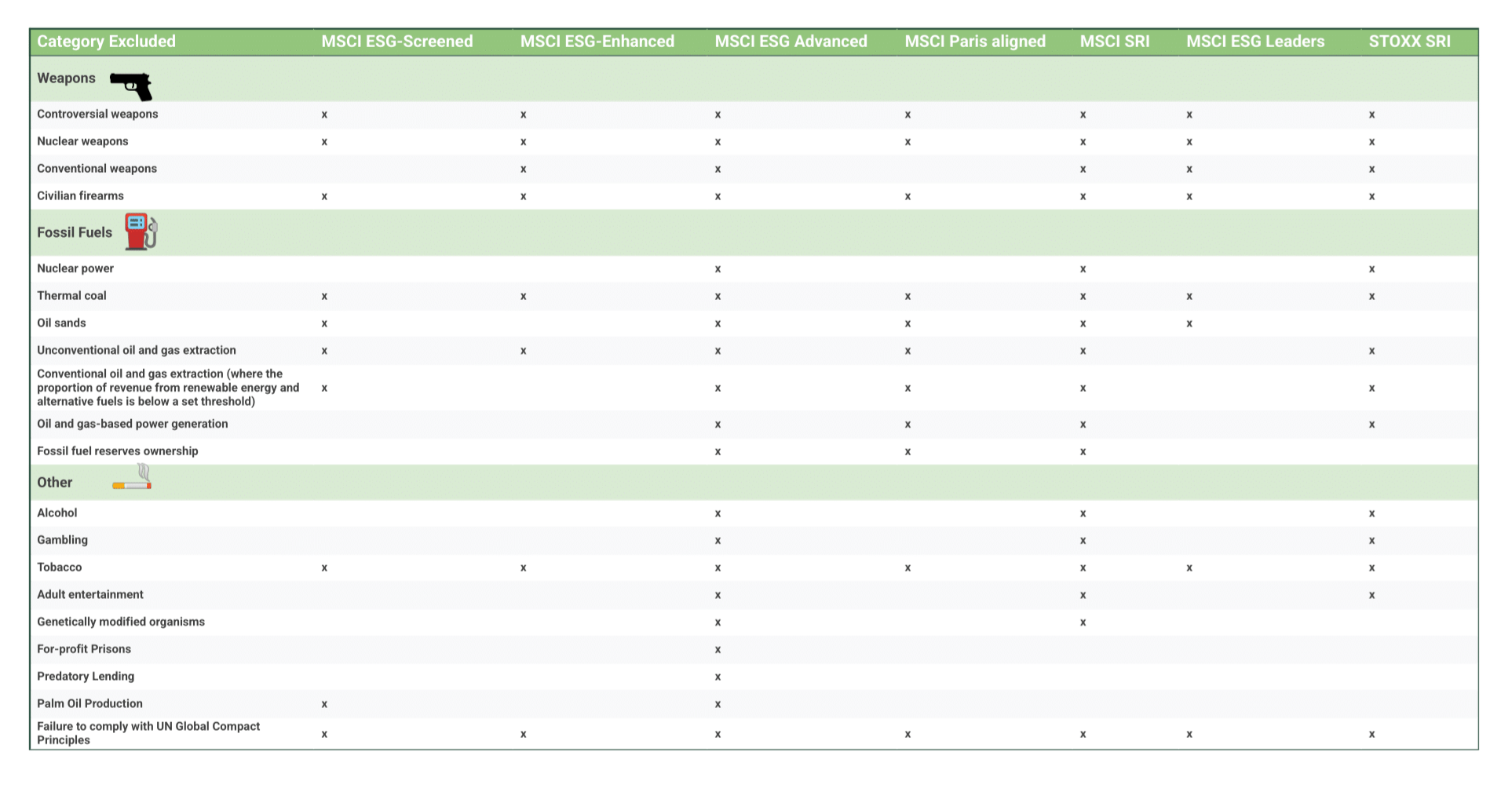
Starting from a parent index like the MSCI World or MSCI Emerging Markets, the ESG Screened index removes companies in several key categories. Controversial weapons manufacturers are excluded, covering producers of cluster munitions, landmines, biological weapons, chemical weapons and nuclear weapons for non-states. Civilian firearms producers are excluded. Tobacco companies are excluded. Companies significantly involved in major fossil fuel activities are excluded, including oil and gas extraction, thermal coal power plants and Arctic drilling. Companies involved in palm oil with no credible sustainability certification are also excluded.
Beyond sector-based exclusions, the ESG Screened index also removes companies with a very poor ESG controversy score or those in serious violation of UN Global Compact principles, which set baseline standards for corporate behaviour on human rights, labour, the environment and anti-corruption.
Finally the ESG Screened index targets a 30% reduction in carbon intensity compared to the parent index. After applying the sector exclusions, MSCI measures the greenhouse gas emissions intensity of the remaining portfolio and removes the highest-polluting remaining companies if necessary until that 30% reduction threshold is achieved.
In practical terms this means the ESG Screened index still invests broadly across the market and retains many companies that a stricter sustainability investor might object to, including conventional weapons manufacturers and companies with moderate rather than severe controversy scores. It is a meaningful first step beyond a conventional index but is not suitable for investors who want comprehensive ethical screening.
European investors can access the ESG Screened methodology through the iShares MSCI World ESG Screened UCITS ETF and equivalent products covering emerging markets and European equities, all available to research at justETF.
MSCI ESG Enhanced: Going Further
The MSCI ESG Enhanced index applies a wider set of exclusions than the Screened version and reweights the remaining portfolio in favour of companies with higher ESG scores and lower carbon footprints.
In addition to everything excluded by the ESG Screened index, the ESG Enhanced index also removes conventional weapons manufacturers. This is a meaningful distinction. A conventional weapons manufacturer producing tanks, military aircraft or ammunition components would not be excluded by the ESG Screened index but would be removed from the ESG Enhanced index. For investors who object to the mainstream arms industry rather than just its most extreme products, this difference is significant.
The ESG Enhanced index also applies broader fossil fuel exclusions covering thermal coal mining and coal power, oil sands and additional extraction activities. Companies with serious UN Global Compact violations or multiple severe ESG controversies are removed. The remaining portfolio is then reweighted to favour companies with stronger ESG ratings and lower carbon footprints compared to their sector peers.
Like the ESG Screened index, the ESG Enhanced index targets a 30% reduction in carbon intensity versus the parent index. European investors can access this methodology through the iShares MSCI World ESG Enhanced UCITS ETF and equivalent regional variants.
MSCI SRI: The Strictest Standard
The MSCI SRI, or Socially Responsible Investing, index is the strictest tier in the MSCI sustainable index family and is the most appropriate choice for investors who want comprehensive ethical screening rather than a lighter-touch ESG filter.
The SRI index applies all of the exclusions found in the ESG Screened and Enhanced tiers and adds further categories. Alcohol is excluded at meaningful revenue thresholds. Gambling is excluded. Adult entertainment is excluded. Genetically modified organisms are excluded. Any fossil fuel extraction, covering both conventional oil and gas and unconventional sources, is excluded entirely at the SRI level, which is a significantly broader exclusion than either of the lower tiers applies.
Beyond the sector-based exclusions, the SRI index applies an additional quality requirement: all included companies must hold an MSCI ESG rating of A or higher on a scale that runs from AAA at the top to CCC at the bottom. This means passing the exclusion screens is not sufficient on its own. A company must also demonstrate genuinely strong sustainability management across its environmental, social and governance practices. Companies with serious ongoing ESG controversies are removed regardless of their sector classification. The SRI index then typically selects only the top 25% of companies by market capitalisation within each sector from those that pass all screens and rating requirements.
The SRI index does not set a formal carbon intensity reduction target in the same mechanical way the Screened and Enhanced indexes do, since the combination of comprehensive exclusions and high ESG rating requirements naturally produces a significantly lower-carbon portfolio.
European investors can access the SRI methodology through the iShares MSCI World SRI UCITS ETF EUR (Acc), the iShares MSCI EM SRI UCITS ETF and the SPDR STOXX Europe 600 SRI UCITS ETF, all researchable at justETF.
How the Three Types Compare Side by Side
To summarise the key differences clearly across the three MSCI index tiers:
The ESG Screened index removes the most obvious exclusions including controversial weapons, nuclear weapons, tobacco, major fossil fuel activities and serious ESG controversies, while targeting a 30% carbon intensity reduction. Conventional weapons and most other industries remain included.
The ESG Enhanced index does all of this and additionally removes conventional weapons, broader coal and fossil fuel activities, and reweights the portfolio toward higher ESG performers. More companies are removed and those remaining score better on ESG criteria than in the Screened version.
The SRI index applies the broadest exclusions covering all weapons types, tobacco, alcohol, gambling, adult entertainment, GMOs and all fossil fuel extraction, and additionally requires all included companies to hold an MSCI ESG rating of A or above, good controversy scores and selects only the top 25% by market cap per sector. It is the most stringent and most values-aligned option of the three.
The practical implication is that if excluding fossil fuels entirely, including conventional oil and gas, is important to you, you need a fund tracking a Paris-Aligned or SRI-level index, not an ESG-Screened or ESG-Enhanced one. The difference between these tiers is substantial and is not always obvious from the fund name alone. There are many more ESG labels, some of them can be seen below compared side-by-side:
Third-Party Screening Tools: ESG Ratings, Controversy Scores and Human Rights
Many sustainable ETFs, particularly those tracking SRI-level indices, supplement their sector-based exclusion criteria with independent third-party assessments. Understanding what these tools measure helps you evaluate the robustness of a fund’s sustainability claims.
The ESG rating, most commonly provided by MSCI or Sustainalytics, assesses how well a company manages environmental, social and governance risks and opportunities relative to its industry peers. It provides a standardised grade, running from AAA at the top to CCC at the bottom under MSCI’s scale, that allows direct comparison across companies within the same sector. The rating focuses on factors most likely to have a material impact on a company’s long-term financial performance, making it a tool that serves both sustainability and financial risk assessment simultaneously.
The controversy score measures a company’s involvement in specific ESG-related incidents rather than its overall management practices. These controversies might include major oil spills, labour rights violations, product safety failures, bribery cases or governance scandals. Each controversy is assessed based on its severity, the company’s direct or indirect involvement and whether the incident is ongoing, concluded or historically relevant. A company with repeated severe controversies will see its overall ESG rating fall, but controversy scores are also used as a standalone filter to exclude companies currently involved in serious incidents regardless of their general ESG standing.
The human rights controversy score is a more specific tool that focuses on whether a company’s operations or supply chain practices are associated with human rights violations. It is used by investors with a particular emphasis on social justice and labour rights as an additional layer of screening beyond the general ESG rating. High human rights controversy scores also reduce a company’s overall ESG rating, but examining this dimension separately allows for more targeted screening on this specific concern.
For funds like the VanEck ESGI and GRNV, which follow MSCI SRI methodology, the ESG rating requirement is particularly stringent: companies must hold a rating of A, AA or AAA for six consecutive quarters to be eligible for inclusion, and must maintain an ESG Controversy Score of at least 2 out of 10 and a Human Rights Controversy Score of at least 5 out of 10 for four consecutive quarters. These time-based stability requirements prevent companies from gaming their way into the index with a temporary improvement in scores.
Sustainable ETF Options for Australian Investors
Australian investors have a well-developed range of sustainable ETF options on the ASX. The four most relevant funds are covered here, each applying a distinct methodology worth understanding before investing.
BetaShares Global Sustainability Leaders ETF (ETHI)
ETHI tracks a Climate Leaders Index that first selects companies in the top one-third of their industry for carbon efficiency, measured as emissions per dollar of revenue, or companies that help avoid emissions by commercialising solutions like renewable energy, energy efficiency, sustainable land use or carbon capture. A fossil fuel screen then excludes firms with direct or significant fossil fuel exposure from this climate-positive starting pool.
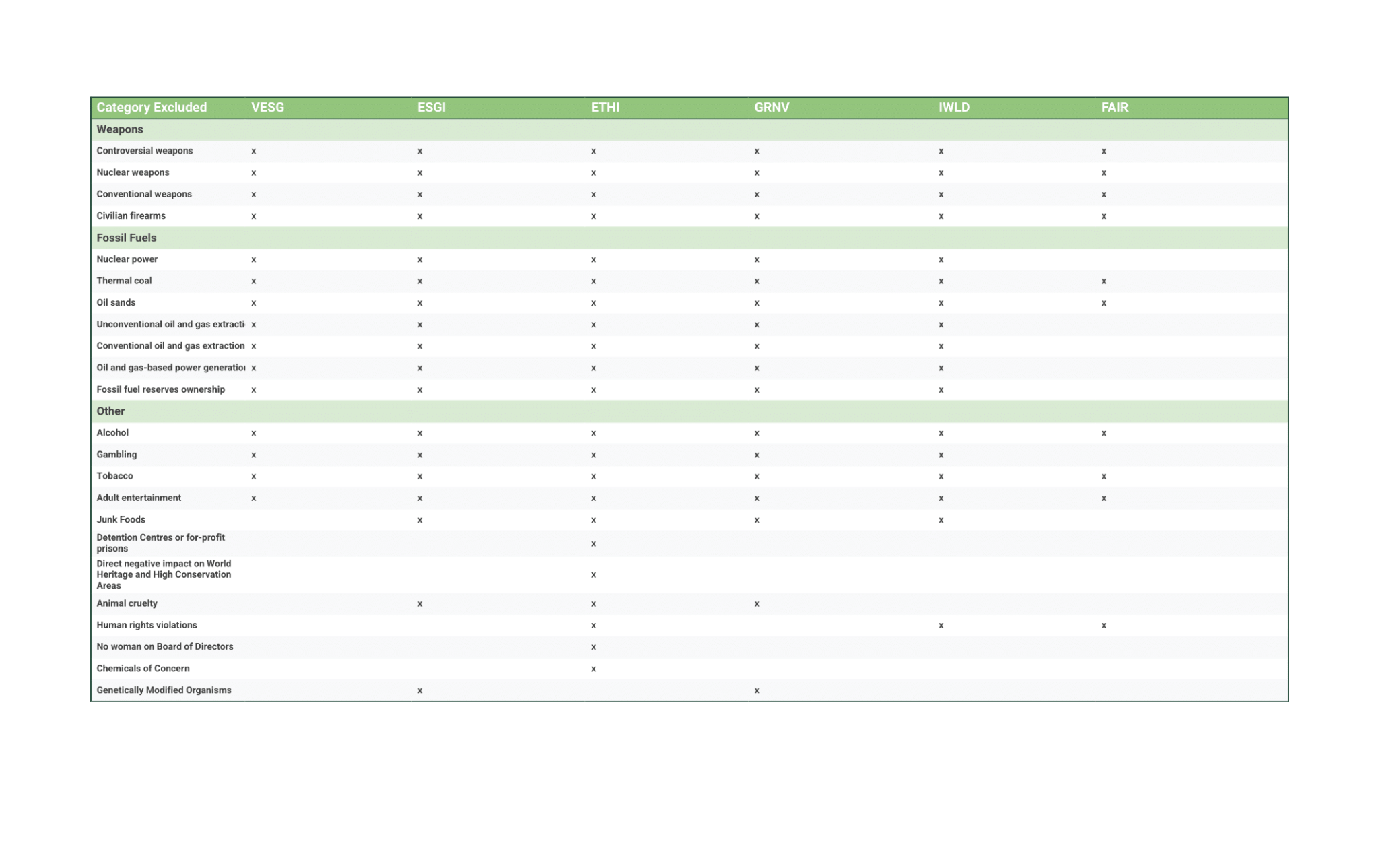
ETHI’s ethical screen is the most comprehensive of any major ASX-listed sustainable ETF by breadth of exclusions. Excluded categories cover gambling, tobacco, armaments, nuclear energy, environmental destruction of heritage-listed areas, animal cruelty, alcohol, junk food, pornography, human rights abuses, payday lending and a lack of board diversity. Companies exposed to significant ESG-related reputational risk or controversy may also be excluded at the discretion of the Responsible Investment Committee. Of the major ASX sustainable ETFs, ETHI applies the widest range of explicit exclusion criteria.
VanEck MSCI International Sustainable Equity ETF (ESGI)
ESGI tracks the MSCI World ex Australia IMI Select SRI Screened Index, applying full MSCI SRI methodology to international developed and emerging market equities outside Australia. Exclusions cover adult entertainment, alcohol, gambling, tobacco, nuclear power, conventional and controversial weapons, and fossil fuels including coal, oil, gas, oil sands and Arctic drilling.
Beyond sector exclusions, ESGI requires all included companies to hold an MSCI ESG rating of A, AA or AAA maintained for six consecutive quarters, an ESG Controversy Score of at least 2 out of 10 maintained for four consecutive quarters, and a Human Rights Controversy Score of at least 5 out of 10 maintained for four consecutive quarters. Approximately 40% of holdings are US-based. ESGI and GRNV apply the same exclusion criteria and rating requirements, differing only in their geographic focus.
VanEck MSCI Australian Sustainable Equity ETF (GRNV)
GRNV applies the same MSCI SRI exclusion criteria and ESG rating requirements as ESGI but focuses exclusively on Australian-listed companies. It tracks the MSCI Australia IMI Select SRI Screened Index. For Australian investors who want home-market exposure with full sustainable screening, GRNV eliminates currency risk and simplifies tax reporting. Five-year historical return was approximately 10.52% per annum on a $10,000 investment.
Vanguard Ethically Conscious International Shares Index ETF (VESG)
VESG tracks the FTSE Developed ex-Australia Choice Index and applies moderate ethical screening with broad global diversification. Exclusions cover fossil fuels including exploration and refining, nuclear power and weapons, tobacco, alcohol, gambling, adult entertainment and controversial weapons such as cluster munitions and landmines. VESG also requires all included companies to comply with UN Global Compact principles, which set baseline standards for human rights, labour, the environment and anti-corruption.
VESG is less strict than SRI-level ETFs in that it does not apply the MSCI third-party ESG rating requirement. It does not require companies to hold a minimum ESG rating to be eligible. Instead it relies on FTSE’s exclusion criteria and UN Global Compact compliance assessment. This makes it broader in terms of company coverage than ESGI or GRNV but less stringent in its positive selection requirements.
Sustainable ETF Options for US Investors
US investors cannot purchase UCITS ETFs domiciled in Ireland or Luxembourg, which means the European products discussed above are not directly accessible. However, Vanguard and iShares offer comparable domestically listed products that provide similar sustainable coverage at competitive expense ratios.
Vanguard ESG US Stock ETF (ESGV)
ESGV tracks the FTSE US All Cap Choice Index and applies exclusions covering fossil fuels, tobacco, weapons including controversial and conventional weapons, adult entertainment, gambling and companies failing UN Global Compact principles. It covers large, mid and small-cap US equities. TER 0.09% with approximately $13.4 billion in assets under management.
Vanguard ESG International Stock ETF (VSGX)
VSGX tracks the FTSE Global All Cap ex US Choice Index and applies the same exclusion criteria to international developed and emerging market equities outside the US. It holds over 6,000 companies globally. TER 0.10%. Together ESGV and VSGX provide US investors with fully screened global equity coverage comparable to the European SRI products.
iShares MSCI USA ESG Select ETF (SUSA)
SUSA tracks the MSCI USA ESG Select Index and targets US companies with high ESG ratings relative to their sector peers. It applies positive ESG selection rather than purely exclusionary screening, making it a different but complementary approach to the Vanguard products. TER 0.25%.
iShares MSCI KLD 400 Social ETF (DSI)
DSI tracks the MSCI KLD 400 Social Index, one of the longest-running ESG indexes in the US, launched in 1990. It applies exclusionary and positive ESG criteria to 400 US companies. For US investors who want a long-established product with a track record spanning multiple market cycles, DSI is worth researching. TER 0.25%.
For US investors building a globally diversified sustainable portfolio, combining ESGV and VSGX for the equity allocation alongside the Vanguard Total World Bond ETF (BNDW) for fixed income produces a fully screened global portfolio at a weighted average cost below 0.10% per year, one of the lowest-cost sustainable portfolios available anywhere in the world.
How to Choose the Right Sustainable ETF for Your Values
The most important thing to understand is that there is no single correct answer. The right sustainable ETF for you depends on your specific values and which industries or practices you most want to avoid or support.
Start by asking yourself a set of practical questions. Do I want to exclude fossil fuels entirely, or am I comfortable holding companies that are transitioning away from fossil fuels even if they still have some exposure? Do I want to exclude conventional weapons, or am I comfortable with mainstream defence industry exposure and only want to avoid the most controversial weapon types? Do I care about alcohol, gambling and adult entertainment exclusions, or are those industries less important to my values than climate-related ones?
The answers to these questions map directly onto the index tier that suits you. If your primary concern is avoiding the most egregious industries, ESG Screened provides a meaningful starting point. If conventional weapons exclusion matters to you, you need at least ESG Enhanced. If you want comprehensive ethical alignment including fossil fuels, alcohol, gambling and adult entertainment, plus the assurance of independent third-party ESG rating requirements, an SRI-level fund is the appropriate choice.
Once you have identified the right methodology, check the actual holdings rather than relying on the label alone. The top twenty to fifty holdings of any sustainable ETF are published on the fund provider’s website and on research platforms. Scanning these confirms whether the fund’s methodology is producing the portfolio you expect. Use independent tools like Sustainalytics and S&P Global ESG Scores to verify the sustainability credentials of significant holdings independently of the fund provider’s own claims.
Key Takeaways
The sustainable ETF landscape offers genuinely meaningful options for investors who want to align their portfolios with their values, but the label on a fund is only the starting point. The MSCI ESG Screened index removes the most obvious exclusions while still investing broadly, making it the lightest of the three main tiers. The ESG Enhanced index adds conventional weapons exclusions and broader fossil fuel coverage. The SRI index applies the most comprehensive exclusions across weapons, tobacco, alcohol, gambling, adult entertainment and all fossil fuel extraction, and additionally requires all included companies to hold a minimum MSCI ESG rating of A, strong controversy scores and good human rights scores, with these requirements maintained over consecutive quarters to ensure stability.
Australian investors have strong options including ETHI, which applies the broadest exclusion criteria of any major ASX sustainable ETF, alongside ESGI, GRNV and VESG, which offer different combinations of exclusion depth and geographic coverage. US investors can build a fully screened global portfolio using ESGV and VSGX at a weighted average cost below 0.10% per year.
The choice between these products is ultimately a personal one driven by your values. Understanding what each fund actually excludes, and verifying those claims against the actual holdings, is the only reliable way to ensure your investment portfolio genuinely reflects the world you want your money to help build.
Frequently Asked Questions
What is the difference between ESG Screened and SRI?
ESG Screened is the lightest tier, removing only the most obvious problematic companies including controversial weapons, tobacco and major fossil fuels while applying a 30% carbon intensity reduction target. SRI is the strictest tier, applying comprehensive exclusions across weapons, tobacco, alcohol, gambling, adult entertainment and all fossil fuel extraction, and additionally requiring all included companies to hold a minimum MSCI ESG rating of A with stable controversy and human rights scores over multiple consecutive quarters.
Does an SRI ETF still hold fossil fuel companies?
No, at the SRI level all fossil fuel extraction is excluded, covering both conventional oil and gas and unconventional sources. At the ESG Screened level some fossil fuel companies may still be included unless their greenhouse gas intensity is extreme. If fossil fuel exclusion is important to you, confirm your chosen fund tracks a Paris-Aligned or SRI-level index.
Can Australian investors access European UCITS sustainable ETFs?
Yes, through platforms like Interactive Brokers, Australian investors can access European UCITS ETFs including the iShares MSCI World SRI UCITS ETF. Currency conversion costs apply since Australian dollars must be converted to euros or US dollars, and tax reporting becomes more complex. ASX-listed products like ETHI, ESGI, GRNV and VESG provide comparable coverage with simpler access and no currency conversion.
Can US investors use the same sustainable ETFs as European investors?
No. UCITS ETFs domiciled in Ireland or Luxembourg are not available for purchase by US investors under US securities regulations. US investors should use domestically listed equivalents including ESGV and VSGX from Vanguard, which apply comparable exclusion criteria at similarly low expense ratios.
What does the MSCI ESG rating scale mean?
MSCI rates companies from AAA at the top, reflecting industry-leading ESG management, through AA, A, BBB, BB, B and CCC at the bottom, reflecting industry laggards with serious unmanaged ESG risks. SRI-level ETFs typically require a minimum rating of A, meaning only the top two tiers, AAA and AA, plus A-rated companies, are eligible. This requirement eliminates the roughly 75% of companies that score below A and ensures the fund holds only companies with demonstrably strong ESG management practices.
Is ETHI or VESG more suitable for Australian investors?
They serve different purposes. ETHI applies the broadest exclusion criteria of any major ASX sustainable ETF and starts from a climate leaders universe, making it the most appropriate choice for investors who prioritise comprehensive ethical and climate screening. VESG applies moderate ethical screening with a broader company universe, making it more diversified across sectors and geographies. Many investors hold both in combination, using VESG for its breadth and ETHI for its screening rigour across a smaller allocation.
This article is for educational purposes only and does not constitute financial advice. Impact Wealth International is an education platform only and does not provide personalised investment advice or financial services. Investing involves risk, including possible loss of principal. Past performance is not a reliable indicator of future results. Always conduct your own independent research and consider seeking advice from a qualified financial adviser in your country of residence before making any investment decisions. This does not constitute a recommendation of any specific product. This website is not affiliated with, endorsed by or sponsored by MSCI, Sustainalytics, S&P Global or any other third-party data provider referenced in this article. All trademarks and intellectual property remain the property of their respective owners.