By Leon Robin · Published 15 June 2026 · Last updated 21 June 2026 · 8 min read
Table of Contents
- Why Portfolio Diversification Matters in ETF Investing
- Geographic Factors: How Your Location Impacts Your ETF Strategy
- How to Choose the Best ETFs: A Checklist for Investors
- Best ETF Portfolio Examples for European Investors (UCITS)
- Best ETF Portfolio Examples for Australian Investors (ASX)
- Best ETF Portfolio Examples for US Investors
- Sustainable Investing: Understanding ESG vs SRI ETF Exclusion Criteria
- 4 Common ETF Investing Mistakes (And How to Avoid Them)
- Key Takeaways: Your Blueprint for Long-Term Wealth
- Frequently Asked Questions About Building an ETF Portfolio
Why Portfolio Diversification Matters in ETF Investing
Diversification is the single most important structural principle in ETF portfolio construction. It means spreading your money across enough different companies, sectors and regions that no single event can cause serious permanent damage to your overall portfolio. This applies whether the event is a banking crisis in Europe, a technology downturn in the US or political instability in an emerging market.
A well-diversified ETF portfolio typically holds exposure across thousands of companies spanning multiple continents. When one region or sector struggles, others often continue to perform. As a result, the overall trajectory of your portfolio smooths out over time. This is what allows a long-term investor to stay calm during short-term market volatility, because their portfolio is not dependent on any single outcome.
There are three dimensions of diversification worth building into a portfolio. The first is geographic spread across developed markets, emerging markets and your home market. The second is sector spread across technology, healthcare, financials, consumer goods, energy and industrials. The third, used in more advanced portfolios, is asset class spread incorporating bonds and real estate alongside equities. The portfolio options in this guide cover the first two dimensions in straightforward, beginner-accessible combinations.
Geographic Factors: How Your Location Impacts Your ETF Strategy
Before selecting specific ETFs, it helps to understand that your country of residence directly shapes which products are available, what they cost and how they are taxed.
European investors primarily invest through exchanges including Euronext, Xetra or the London Stock Exchange. They typically have access to UCITS-compliant ETFs, a regulatory standard that makes European-domiciled funds the most accessible choice for most beginners. Australian investors primarily invest through the ASX, which has a well-developed and growing range of ETF products. US investors have access to one of the deepest ETF markets in the world. However, they cannot purchase UCITS ETFs, so domestically listed equivalents from providers like Vanguard, iShares and Schwab are the relevant alternative.
Currency exposure is another practical consideration. If your income and bank account are in Australian dollars and you invest in an ETF denominated in euros, your returns depend on more than the ETF’s performance alone. They also depend on movements in the exchange rate between those two currencies. Investing in ETFs denominated in your home currency generally reduces this complexity. Where currency conversion is unavoidable, platforms like Interactive Brokers provide transparent and relatively low-cost conversion.
Tax treatment also varies significantly by location. Consider checking the specific rules in your jurisdiction with a qualified tax adviser before investing.
How to Choose the Best ETFs: A Checklist for Investors
Before adding any ETF to your portfolio, many investors run through a research checklist. A detailed explanation of each criterion is available in the Guide to researching ETFs.
In summary, the key things many investors confirm are strong and consistent performance history over at least five years, an expense ratio below 0.2% for broad index funds, genuine geographic and sector diversification, and physical replication of the underlying index rather than synthetic replication. Additionally, a fund volume above $500 million is often used as a signal of stability, alongside a fund age of at least five years.
For sustainable portfolios, it is also worth confirming what the fund explicitly excludes, such as fossil fuels, tobacco and weapons. Many investors verify the top holdings against independent ESG rating platforms such as Sustainalytics or S&P Global ESG Scores.
Best ETF Portfolio Examples for European Investors (UCITS)
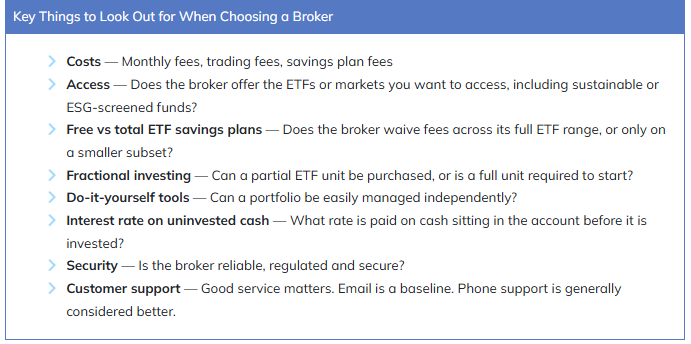
European investors have access to a strong range of UCITS ETFs through brokers including Trade Republic* and Interactive Brokers*. Researching all options at justETF before investing is widely recommended.
Standard Global Growth Portfolios (50/30/20 & 70/30 Structures)
This three-fund portfolio provides broad global exposure with a tilt toward developed and emerging markets, alongside European representation.
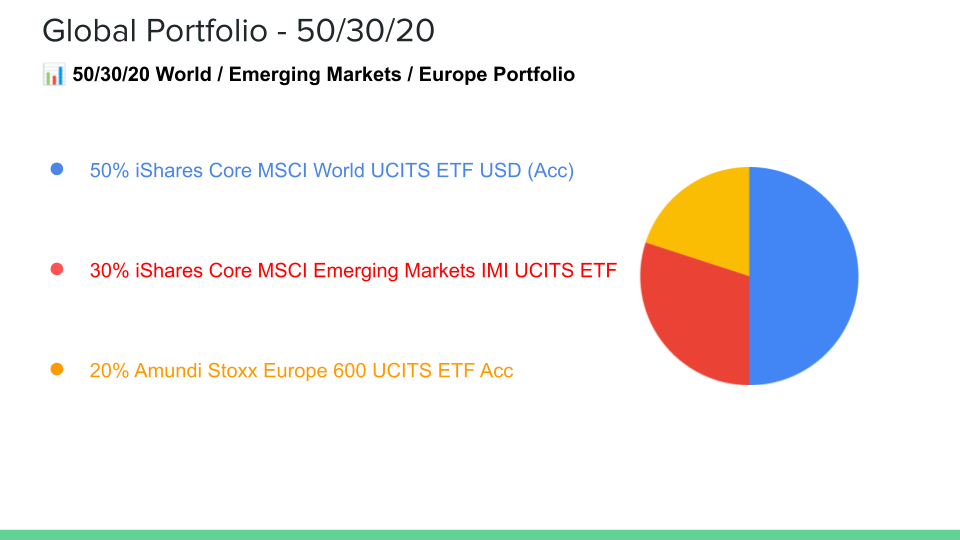
50% iShares Core MSCI World UCITS ETF USD (Acc): Large fund size, many holdings across many countries. strong long-term returns. Physical replication. Accumulating. Approximately 70% US weighted, which is worth understanding for your overall geographic allocation.
30% iShares Core MSCI Emerging Markets IMI UCITS ETF: approximately 3,000 companies across China, Taiwan, India, South Korea, Brazil, Saudi Arabia and South Africa. Fund size approximately €21 billion. Five-year return approximately 60%. TER 0.18%. Physical replication. Accumulating.
20% Amundi Stoxx Europe 600 UCITS ETF Acc: 608 holdings across major European markets including the UK, France, Switzerland, Germany and the Netherlands. Fund size approximately €10 billion. Five-year return approximately 114%. TER 0.07%. Accumulating. Launched 2013.
If you had invested €10,000 in this portfolio five years ago, it would have grown to approximately €18,715, a return of roughly 17% per annum. Past performance does not predict future returns.
A simpler two-fund version of this structure uses a 70/30 split: 70% iShares Core MSCI World UCITS ETF USD (Acc) and 30% iShares Core MSCI Emerging Markets IMI UCITS ETF. This combination covers the US, Asia and major global markets with strong historical growth and thousands of underlying holdings. It is one of the more widely used passive portfolio structures among European retail investors.
Global Dividend Portfolio for Passive Income
For investors who want regular income alongside long-term growth.
70% SPDR S&P Global Dividend Aristocrats UCITS ETF, dividend yield approximately 5.4%. 30% iShares Emerging Markets Dividend UCITS ETF, dividend yield approximately 7.88%.
A high dividend yield is worth examining carefully. Companies paying large dividends are distributing profits rather than reinvesting them into growth, which can slow the fund’s capital appreciation over time. Dividend ETFs tend to suit investors who want regular cash flow rather than maximum long-term compounding. For beginners focused on building wealth over decades, a growth-oriented accumulating portfolio is one option many consider.
Sustainable and ESG ETF Portfolios for Europe
For investors who want to align their portfolio with their values without sacrificing diversification.
50% iShares MSCI World SRI UCITS ETF EUR (Acc): excludes tobacco, thermal coal, civilian firearms, controversial weapons, nuclear power and companies with serious ESG controversies. 30% iShares MSCI EM SRI UCITS ETF: applies the same SRI screening criteria to emerging market companies. 20% SPDR STOXX Europe 600 SRI UCITS ETF: applies SRI screening to European large and mid-cap companies.
A simpler version uses a 70/30 split between the iShares MSCI World SRI UCITS ETF EUR (Acc) and the iShares MSCI EM SRI UCITS ETF.
Best ETF Portfolio Examples for Australian Investors (ASX)
Australian investors have a strong range of ASX-listed ETF options. Researching all products at the ASX website before investing is recommended. Interactive Brokers also allows Australian investors to access European UCITS ETFs, though currency conversion costs should be factored in.
Core Global Growth Portfolios for Aussie Investors
50% Vanguard MSCI Index International Shares ETF (VGS): broad international shares with a strong US component. One of the most widely held ETFs on the ASX. 30% iShares MSCI Emerging Markets ETF (IEM): exposure to China, Taiwan, Japan, South Korea and other major emerging economies. 20% iShares Europe ETF (IEU): European large and mid-cap companies across major EU markets.
If you had invested AUD $10,000 in this portfolio five years ago, it would have grown to approximately AUD $15,471, representing approximately 10.03% per annum. Past performance does not predict future returns.
A simpler two-fund 70/30 version uses Vanguard MSCI Index International Shares ETF (VGS) and iShares MSCI Emerging Markets ETF (IEM). VGS is described as an international shares ETF, yet it carries a very strong US component. Understanding the geographic weighting before investing is worthwhile, as is considering whether to complement it with a more explicitly European or Australian-focused ETF for balance.
Sustainable and Ethical ETF Portfolios (ASX Options)
This four-fund portfolio balances global sustainable coverage with Australian exposure.
30% Vanguard Ethically Conscious International Shares Index ETF (VESG): excludes fossil fuels, weapons, tobacco, gambling, adult entertainment and companies breaching UN Global Compact principles. 30% iShares MSCI Emerging Markets ETF (IEM): not a sustainable ETF, but included to provide emerging markets exposure, since genuinely sustainable emerging markets ETFs with strong track records remain limited on the ASX. 20% VanEck MSCI International Sustainable Equity ETF (ESGI): excludes adult entertainment, alcohol, animal husbandry, civilian firearms, conventional weapons, controversial weapons, fossil fuels, gambling, GMOs, nuclear power, nuclear weapons, tobacco and soft drinks, and uses MSCI ESG ratings to assess remaining holdings. 20% VanEck MSCI Australian Sustainable Equity ETF (GRNV): applies the same exclusion criteria as ESGI to Australian-listed companies. Five-year return approximately 10.52% per annum on a $10,000 investment, growing to approximately AUD $15,800.
A variation replaces ESGI with iShares Europe ETF (IEU) for investors who prefer broader European coverage without sustainability screening on that allocation, alongside VESG, IEM and GRNV. Five-year return on this combination on AUD $10,000 was approximately 10.03% per annum.
Best ETF Portfolio Examples for US Investors
US investors have one of the most competitive ETF markets in the world. They can build highly diversified portfolios at very low cost, though UCITS ETFs are not available. Researching options at ETF Database or directly through fund providers is recommended.
Before investing in a standard taxable brokerage account, many US investors consider maximising contributions to a Roth IRA first, since it allows tax-free growth and withdrawals in retirement. The 2026 annual contribution limit is $7,000 for most investors.
Low-Cost Total Market Portfolios
70% Vanguard Total World Stock ETF (VT): covers developed and emerging market equities globally in a single fund. TER 0.07%. One of the more cost-effective ways to own the entire global equity market. 30% Vanguard Total Bond Market ETF (BND): broad US investment-grade bond exposure as a stabilising allocation. TER 0.03%.
An alternative 50/30/20 structure uses 50% iShares Core MSCI World ETF (URTH): developed market global equity exposure. 30% iShares MSCI Emerging Markets ETF (EEM): emerging markets exposure including China, Taiwan, India and South Korea. 20% Vanguard FTSE Europe ETF (VGK): European equity exposure across major developed European markets.
Sustainable and ESG ETF Asset Allocation
70% split between approximately 50% Vanguard ESG US Stock ETF (ESGV) and approximately 50% Vanguard ESG International Stock ETF (VSGX) within the equity allocation. Together they cover US and international developed and emerging market equities with ESG screens excluding fossil fuels, tobacco, weapons and companies failing UN Global Compact principles. ESGV TER 0.09%. VSGX TER 0.10%. 30% Vanguard Total World Bond ETF (BNDW): global investment-grade bond exposure. TER 0.05%.
Sustainable Investing: Understanding ESG vs SRI ETF Exclusion Criteria
Not all sustainable ETFs apply the same screens. Understanding the differences helps you choose a fund that genuinely aligns with your values. The summary below covers the exclusion criteria applied by the major MSCI-based sustainable index families, which underpin many of the ETFs listed in this guide.
Controversial weapons are excluded across every category from MSCI ESG-Screened through to MSCI SRI. Nuclear weapons are similarly excluded across all tiers. Thermal coal exclusions begin at the MSCI ESG-Enhanced level and apply to all higher tiers. Full fossil fuel exclusion, including conventional oil and gas, only applies at the MSCI Paris-Aligned and MSCI SRI levels. Tobacco exclusions apply from MSCI ESG-Screened onwards. Alcohol, gambling and adult entertainment exclusions appear at the MSCI ESG-Advanced level and above.
For investors using the STOXX SRI index, exclusions cover conventional weapons, civilian firearms, controversial weapons, nuclear weapons and tobacco, broadly comparable to MSCI SRI.
The key practical takeaway is that a fund labelled ESG-Screened is considerably less restrictive than one labelled SRI. If fossil fuel exclusion matters to you specifically, it is worth confirming that your chosen fund applies Paris-Aligned or SRI-level screens rather than basic ESG-Screened criteria.
4 Common ETF Investing Mistakes (And How to Avoid Them)
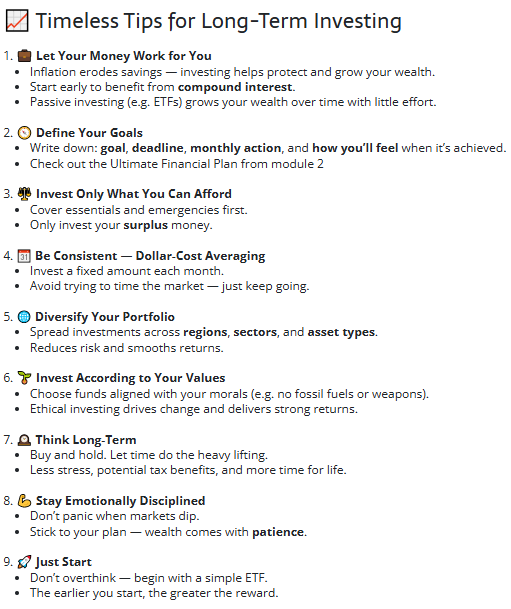
Changing your portfolio too often. Frequent trading generates higher costs and erodes returns. In some countries it may also reduce your eligibility for certain tax benefits. Many investors choose a portfolio structure, set up an automated monthly contribution and review it only once or twice a year. Passive investing works partly because it removes the temptation to react to short-term noise.
Buying overlapping ETFs without realising it. If your global ETF and your sustainable world ETF both hold Microsoft, Apple and Alphabet at significant weightings, you are not as diversified as you think. Before adding a new ETF, checking the top ten holdings of everything you already own is worthwhile. True diversification requires genuine spread, not the appearance of it.
Following hype without doing your own research. A compelling narrative, a friend’s recommendation or a viral article about a hot sector is not on its own a basis for investment. Many investors apply a consistent research checklist to every ETF independently of whatever prompted them to look at it in the first place.
Not having a clear plan. Setting specific long-term goals, whether that is financial independence, buying a home or retiring early, and breaking those goals into monthly contribution targets, is a widely used approach. Tracking progress periodically and staying disciplined when markets move in uncomfortable ways tends to support consistency. Investing is a long-term endeavour, and the strategy that compounds most effectively is one sustained through all market conditions, not just the comfortable ones.
Key Takeaways: Your Blueprint for Long-Term Wealth
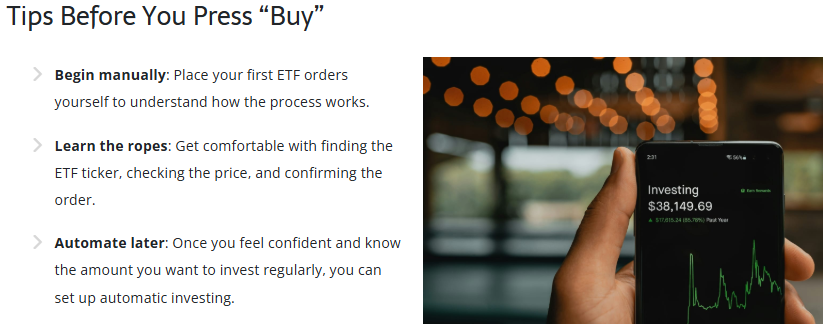
Building a diversified ETF portfolio does not require sophisticated knowledge or large amounts of capital. It requires a clear geographic allocation, a small number of well-chosen funds that pass a research checklist, an automated monthly contribution and the patience to stay invested over the long term.
European investors have low-cost options anchored by the iShares MSCI World and Emerging Markets UCITS ETFs. Australian investors can build a globally diversified portfolio using VGS and IEM as a core, with sustainable additions through VESG, ESGI and GRNV. US investors have access to strong value through Vanguard’s total market products, and many prioritise tax-advantaged accounts before investing in taxable ones.
Avoiding overlap, avoiding excessive trading and avoiding hype-driven decisions are all worth keeping in mind. So is starting as early as possible. The most important variable in long-term portfolio performance is often not which specific ETFs you choose. It is how consistently and how early you begin contributing.
Frequently Asked Questions About Building an ETF Portfolio
How many ETFs do I need in a portfolio?
Two to four well-chosen ETFs is sufficient for most beginner investors. More than five or six rarely adds meaningful diversification and usually introduces unnecessary overlap and complexity. Starting simple and adding only for a specific reason is a widely used approach. This is general educational information and not a recommendation for your specific situation.
Should I invest a lump sum or contribute monthly?
Both approaches can work over long time horizons. Monthly contributions through dollar cost averaging reduce the risk of investing a large amount at a market peak and build a consistent investing habit. If you have a lump sum available, investing it promptly and then continuing monthly contributions is one approach some investors take. This is educational context only and does not constitute a recommendation.
How do I avoid overlap between ETFs?
Checking the top ten holdings of every ETF you own or plan to add is a practical first step. If the same companies appear at significant weightings across multiple funds, you may have hidden concentration rather than genuine diversification. justETF for European ETFs, ETF Database for US ETFs and the ASX fund profiles for Australian ETFs all allow you to compare holdings side by side.
Can I add a sustainable ETF to an existing standard portfolio?
Yes, this is a common approach. Many investors hold a core broad-market ETF alongside one or two sustainable ETFs, balancing diversification with values alignment. Checking for overlap before adding, and ensuring the combined allocation still reflects your intended geographic spread, is worth doing.
How often should I rebalance?
Once or twice a year is a commonly used frequency among passive investors. Directing new monthly contributions toward whichever allocation has fallen below its target weight, before selling anything, tends to minimise transaction costs and avoids triggering unnecessary capital gains events. Tax treatment of any rebalancing activity varies by country, so consulting a qualified adviser is worthwhile for your specific situation.
Why Portfolio Diversification Matters in ETF Investing
Diversification is the single most important structural principle in ETF portfolio construction. It means spreading your money across enough different companies, sectors and regions that no single event can cause serious permanent damage to your overall portfolio. This applies whether the event is a banking crisis in Europe, a technology downturn in the US or political instability in an emerging market.
A well-diversified ETF portfolio typically holds exposure across thousands of companies spanning multiple continents. When one region or sector struggles, others often continue to perform. As a result, the overall trajectory of your portfolio smooths out over time. This is what allows a long-term investor to stay calm during short-term market volatility, because their portfolio is not dependent on any single outcome.
There are three dimensions of diversification worth building into a portfolio. The first is geographic spread across developed markets, emerging markets and your home market. The second is sector spread across technology, healthcare, financials, consumer goods, energy and industrials. The third, used in more advanced portfolios, is asset class spread incorporating bonds and real estate alongside equities. The portfolio options in this guide cover the first two dimensions in straightforward, beginner-accessible combinations.
Geographic Factors: How Your Location Impacts Your ETF Strategy
Before selecting specific ETFs, it helps to understand that your country of residence directly shapes which products are available, what they cost and how they are taxed.
European investors primarily invest through exchanges including Euronext, Xetra or the London Stock Exchange. They typically have access to UCITS-compliant ETFs, a regulatory standard that makes European-domiciled funds the most accessible choice for most beginners. Australian investors primarily invest through the ASX, which has a well-developed and growing range of ETF products. US investors have access to one of the deepest ETF markets in the world. However, they cannot purchase UCITS ETFs, so domestically listed equivalents from providers like Vanguard, iShares and Schwab are the relevant alternative.
Currency exposure is another practical consideration. If your income and bank account are in Australian dollars and you invest in an ETF denominated in euros, your returns depend on more than the ETF’s performance alone. They also depend on movements in the exchange rate between those two currencies. Investing in ETFs denominated in your home currency generally reduces this complexity. Where currency conversion is unavoidable, platforms like Interactive Brokers provide transparent and relatively low-cost conversion.
Tax treatment also varies significantly by location. Consider checking the specific rules in your jurisdiction with a qualified tax adviser before investing.
How to Choose the Best ETFs: A Checklist for Investors
Before adding any ETF to your portfolio, many investors run through a research checklist. A detailed explanation of each criterion is available in the Guide to researching ETFs.
In summary, the key things many investors confirm are strong and consistent performance history over at least five years, an expense ratio below 0.2% for broad index funds, genuine geographic and sector diversification, and physical replication of the underlying index rather than synthetic replication. Additionally, a fund volume above $500 million is often used as a signal of stability, alongside a fund age of at least five years.
For sustainable portfolios, it is also worth confirming what the fund explicitly excludes, such as fossil fuels, tobacco and weapons. Many investors verify the top holdings against independent ESG rating platforms such as Sustainalytics or S&P Global ESG Scores.
Best ETF Portfolio Examples for European Investors (UCITS)
European investors have access to a strong range of UCITS ETFs through brokers including Trade Republic* and Interactive Brokers*. Researching all options at justETF before investing is widely recommended.
Standard Global Growth Portfolios (50/30/20 & 70/30 Structures)
This three-fund portfolio provides broad global exposure with a tilt toward developed and emerging markets, alongside European representation.
50% iShares Core MSCI World UCITS ETF USD (Acc): Large fund size, many holdings across many countries. strong long-term returns. Physical replication. Accumulating. Approximately 70% US weighted, which is worth understanding for your overall geographic allocation.
30% iShares Core MSCI Emerging Markets IMI UCITS ETF: approximately 3,000 companies across China, Taiwan, India, South Korea, Brazil, Saudi Arabia and South Africa. Fund size approximately €21 billion. Five-year return approximately 60%. TER 0.18%. Physical replication. Accumulating.
20% Amundi Stoxx Europe 600 UCITS ETF Acc: 608 holdings across major European markets including the UK, France, Switzerland, Germany and the Netherlands. Fund size approximately €10 billion. Five-year return approximately 114%. TER 0.07%. Accumulating. Launched 2013.
If you had invested €10,000 in this portfolio five years ago, it would have grown to approximately €18,715, a return of roughly 17% per annum. Past performance does not predict future returns.
A simpler two-fund version of this structure uses a 70/30 split: 70% iShares Core MSCI World UCITS ETF USD (Acc) and 30% iShares Core MSCI Emerging Markets IMI UCITS ETF. This combination covers the US, Asia and major global markets with strong historical growth and thousands of underlying holdings. It is one of the more widely used passive portfolio structures among European retail investors.
Global Dividend Portfolio for Passive Income
For investors who want regular income alongside long-term growth.
70% SPDR S&P Global Dividend Aristocrats UCITS ETF, dividend yield approximately 5.4%. 30% iShares Emerging Markets Dividend UCITS ETF, dividend yield approximately 7.88%.
A high dividend yield is worth examining carefully. Companies paying large dividends are distributing profits rather than reinvesting them into growth, which can slow the fund’s capital appreciation over time. Dividend ETFs tend to suit investors who want regular cash flow rather than maximum long-term compounding. For beginners focused on building wealth over decades, a growth-oriented accumulating portfolio is one option many consider.
Sustainable and ESG ETF Portfolios for Europe
For investors who want to align their portfolio with their values without sacrificing diversification.
50% iShares MSCI World SRI UCITS ETF EUR (Acc): excludes tobacco, thermal coal, civilian firearms, controversial weapons, nuclear power and companies with serious ESG controversies. 30% iShares MSCI EM SRI UCITS ETF: applies the same SRI screening criteria to emerging market companies. 20% SPDR STOXX Europe 600 SRI UCITS ETF: applies SRI screening to European large and mid-cap companies.
A simpler version uses a 70/30 split between the iShares MSCI World SRI UCITS ETF EUR (Acc) and the iShares MSCI EM SRI UCITS ETF.
Best ETF Portfolio Examples for Australian Investors (ASX)
Australian investors have a strong range of ASX-listed ETF options. Researching all products at the ASX website before investing is recommended. Interactive Brokers also allows Australian investors to access European UCITS ETFs, though currency conversion costs should be factored in.
Core Global Growth Portfolios for Aussie Investors
50% Vanguard MSCI Index International Shares ETF (VGS): broad international shares with a strong US component. One of the most widely held ETFs on the ASX. 30% iShares MSCI Emerging Markets ETF (IEM): exposure to China, Taiwan, Japan, South Korea and other major emerging economies. 20% iShares Europe ETF (IEU): European large and mid-cap companies across major EU markets.
If you had invested AUD $10,000 in this portfolio five years ago, it would have grown to approximately AUD $15,471, representing approximately 10.03% per annum. Past performance does not predict future returns.
A simpler two-fund 70/30 version uses Vanguard MSCI Index International Shares ETF (VGS) and iShares MSCI Emerging Markets ETF (IEM). VGS is described as an international shares ETF, yet it carries a very strong US component. Understanding the geographic weighting before investing is worthwhile, as is considering whether to complement it with a more explicitly European or Australian-focused ETF for balance.
Sustainable and Ethical ETF Portfolios (ASX Options)
This four-fund portfolio balances global sustainable coverage with Australian exposure.
30% Vanguard Ethically Conscious International Shares Index ETF (VESG): excludes fossil fuels, weapons, tobacco, gambling, adult entertainment and companies breaching UN Global Compact principles. 30% iShares MSCI Emerging Markets ETF (IEM): not a sustainable ETF, but included to provide emerging markets exposure, since genuinely sustainable emerging markets ETFs with strong track records remain limited on the ASX.
20% VanEck MSCI International Sustainable Equity ETF (ESGI): excludes adult entertainment, alcohol, animal husbandry, civilian firearms, conventional weapons, controversial weapons, fossil fuels, gambling, GMOs, nuclear power, nuclear weapons, tobacco and soft drinks, and uses MSCI ESG ratings to assess remaining holdings.
20% VanEck MSCI Australian Sustainable Equity ETF (GRNV): applies the same exclusion criteria as ESGI to Australian-listed companies.
A variation replaces ESGI with iShares Europe ETF (IEU) for investors who prefer broader European coverage without sustainability screening on that allocation, alongside VESG, IEM and GRNV. Five-year return on this combination on AUD $10,000 was approximately 10.03% per annum.
Best ETF Portfolio Examples for US Investors
US investors have one of the most competitive ETF markets in the world. They can build highly diversified portfolios at very low cost, though UCITS ETFs are not available. Researching options at ETF Database or directly through fund providers is recommended.
Before investing in a standard taxable brokerage account, many US investors consider maximising contributions to a Roth IRA first, since it allows tax-free growth and withdrawals in retirement. The 2026 annual contribution limit is $7,000 for most investors.
Low-Cost Total Market Portfolios
70% Vanguard Total World Stock ETF (VT): covers developed and emerging market equities globally in a single fund. TER 0.07%. One of the more cost-effective ways to own the entire global equity market. 30% Vanguard Total Bond Market ETF (BND): broad US investment-grade bond exposure as a stabilising allocation. TER 0.03%.
An alternative 50/30/20 structure uses 50% iShares Core MSCI World ETF (URTH): developed market global equity exposure. 30% iShares MSCI Emerging Markets ETF (EEM): emerging markets exposure including China, Taiwan, India and South Korea. 20% Vanguard FTSE Europe ETF (VGK): European equity exposure across major developed European markets.
Sustainable and ESG ETF Asset Allocation
70% split between approximately 50% Vanguard ESG US Stock ETF (ESGV) and approximately 50% Vanguard ESG International Stock ETF (VSGX) within the equity allocation. Together they cover US and international developed and emerging market equities with ESG screens excluding fossil fuels, tobacco, weapons and companies failing UN Global Compact principles. ESGV TER 0.09%. VSGX TER 0.10%. 30% Vanguard Total World Bond ETF (BNDW): global investment-grade bond exposure. TER 0.05%.
Sustainable Investing: Understanding ESG vs SRI ETF Exclusion Criteria
Not all sustainable ETFs apply the same screens. Understanding the differences helps you choose a fund that genuinely aligns with your values. The summary below covers the exclusion criteria applied by the major MSCI-based sustainable index families, which underpin many of the ETFs listed in this guide.
Controversial weapons are excluded across every category from MSCI ESG-Screened through to MSCI SRI. Nuclear weapons are similarly excluded across all tiers. Thermal coal exclusions begin at the MSCI ESG-Enhanced level and apply to all higher tiers. Full fossil fuel exclusion, including conventional oil and gas, only applies at the MSCI Paris-Aligned and MSCI SRI levels. Tobacco exclusions apply from MSCI ESG-Screened onwards. Alcohol, gambling and adult entertainment exclusions appear at the MSCI ESG-Advanced level and above.
For investors using the STOXX SRI index, exclusions cover conventional weapons, civilian firearms, controversial weapons, nuclear weapons and tobacco, broadly comparable to MSCI SRI.
The key practical takeaway is that a fund labelled ESG-Screened is considerably less restrictive than one labelled SRI. If fossil fuel exclusion matters to you specifically, it is worth confirming that your chosen fund applies Paris-Aligned or SRI-level screens rather than basic ESG-Screened criteria.
4 Common ETF Investing Mistakes (And How to Avoid Them)
Changing your portfolio too often. Frequent trading generates higher costs and erodes returns. In some countries it may also reduce your eligibility for certain tax benefits. Many investors choose a portfolio structure, set up an automated monthly contribution and review it only once or twice a year.
Buying overlapping ETFs without realising it. If your global ETF and your sustainable world ETF both hold Microsoft, Apple and Alphabet at significant weightings, you are not as diversified as you think. Before adding a new ETF, checking the top ten holdings of everything you already own is worthwhile.
Following hype without doing your own research. A compelling narrative, a friend’s recommendation or a viral article about a hot sector is not on its own a basis for investment.
Not having a clear plan. Setting specific long-term goals and breaking those goals into monthly contribution targets is a widely used approach. Investing is a long-term endeavour, and the strategy that compounds most effectively is one sustained through all market conditions.
Key Takeaways: Your Blueprint for Long-Term Wealth
Building a diversified ETF portfolio does not require sophisticated knowledge or large amounts of capital. It requires a clear geographic allocation, a small number of well-chosen funds that pass a research checklist, an automated monthly contribution and the patience to stay invested over the long term.
European investors have low-cost options anchored by the iShares MSCI World and Emerging Markets UCITS ETFs. Australian investors can build a globally diversified portfolio using VGS and IEM as a core, with sustainable additions through VESG, ESGI and GRNV.
Frequently Asked Questions About Building an ETF Portfolio
How many ETFs do I need in a portfolio?
Two to four well-chosen ETFs is sufficient for most beginner investors. More than five or six rarely adds meaningful diversification and usually introduces unnecessary overlap and complexity.
Should I invest a lump sum or contribute monthly?
Both approaches can work over long time horizons. Monthly contributions through dollar cost averaging reduce the risk of investing a large amount at a market peak and build a consistent investing habit.
How do I avoid overlap between ETFs?
Checking the top ten holdings of every ETF you own or plan to add is a practical first step. If the same companies appear at significant weightings across multiple funds, you may have hidden concentration rather than genuine diversification.
Can I add a sustainable ETF to an existing standard portfolio?
Yes, this is a common approach. Many investors hold a core broad-market ETF alongside one or two sustainable ETFs, balancing diversification with values alignment.
How often should I rebalance?
Once or twice a year is a commonly used frequency among passive investors. Directing new monthly contributions toward whichever allocation has fallen below its target weight is one approach many investors use.