Why Money Management Is the Foundation of Financial Freedom
Most people think about investing as the path to financial independence. And it is, but only if the foundation underneath it is solid. Without a system for managing your income and expenses, there is no money left over to invest, no safety net when things go wrong, and no clarity about whether you are moving forward or treading water.
Financial freedom, the point at which your investments generate enough passive income to cover your living costs without you needing to work, is not reserved for high earners. It is accessible to almost anyone who starts early, stays consistent and manages the gap between income and spending intelligently over time. A person earning $1,500 a month who saves and invests $150 consistently from their mid-20s will almost certainly accumulate more wealth than a person earning $5,000 a month who spends everything they earn.
The principles that make this possible are not complicated. They are also not commonly taught in school, which is why so many people reach their 30s and 40s having earned a reasonable income for years with very little to show for it in terms of investable assets.
Saving Money is Key: The Maths of Small Decisions
The phrase “living below your means” sounds like it requires sacrifice, but it is really just about becoming conscious of where small amounts of money are quietly disappearing every day without adding much value to your life.
Consider a $5 coffee purchased from a café every working day. On its own it feels insignificant. But five days a week at $5 is $25 per week, roughly $100 per month, and $1,200 per year. That $1,200 invested annually in a broad-market ETF earning an average 10% return per year would grow to approximately $1.7 million over 50 years, thanks to compound interest (see Passive Investing Guide for More Info).
That single example is not an argument for never buying coffee. It is an argument for making deliberate decisions about where your money goes. The goal is not to deprive yourself of enjoyment but to identify the spending that happens on autopilot, that you would not miss if it stopped, and redirect that money somewhere that builds your future. Brewing your own coffee at work, cooking a few meals at home instead of buying lunch, or swapping one expensive habit for a cheaper alternative that delivers the same satisfaction, these small decisions compound over decades into genuinely life-changing amounts.
The discipline required is not deprivation. It is intentionality.
How to Track Your Expenses and Actually Know Where Your Money Goes
You cannot manage what you do not measure. Most people have a rough sense of their major expenses such as rent, utilities and groceries, but have little idea how much is leaving their account on subscriptions, impulse purchases, takeaway meals and small daily transactions.
The first step is simple: track everything for one month. Use a spreadsheet, a budgeting app, or even your bank’s own transaction history. Categorise every outgoing payment and add it up. Most people are genuinely surprised by what they find, not because they are irresponsible, but because small transactions are individually forgettable even when they are collectively significant.
Once you have a clear picture, you can identify the spending that is easy to cut without affecting your quality of life, and the spending that genuinely contributes to your wellbeing and is worth keeping. The goal is not to reduce your spending to zero. It is to make sure your money is going to the things that actually matter to you, and not haemorrhaging quietly into things you barely noticed.
The Six-Month Emergency Fund: Why You Need It Before You Invest
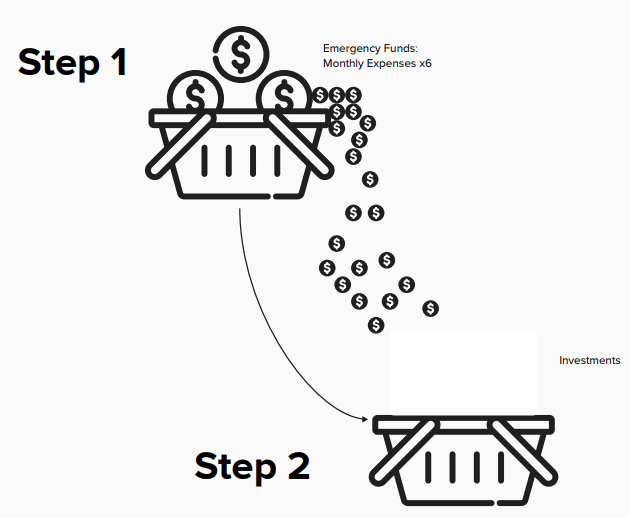
Before directing significant money into investments, every person needs a financial safety net: an emergency fund covering approximately six months of living expenses, held in an accessible savings account.
The purpose of this fund is straightforward. Life is unpredictable. Jobs are lost, cars break down, health issues arise, and unexpected costs appear with no warning. Without a cash buffer, any of these events forces you to either take on debt or liquidate investments, potentially at a loss, to cover the shortfall. With a six-month emergency fund in place, you can handle most financial emergencies without touching your investments at all.
This fund is not an investment. It is not meant to grow. It is meant to be there when you need it, giving you the financial security to make calm, rational decisions rather than panicked ones. Building it is your Step One priority. Once it is fully funded, you can redirect that saving capacity toward investments with confidence.
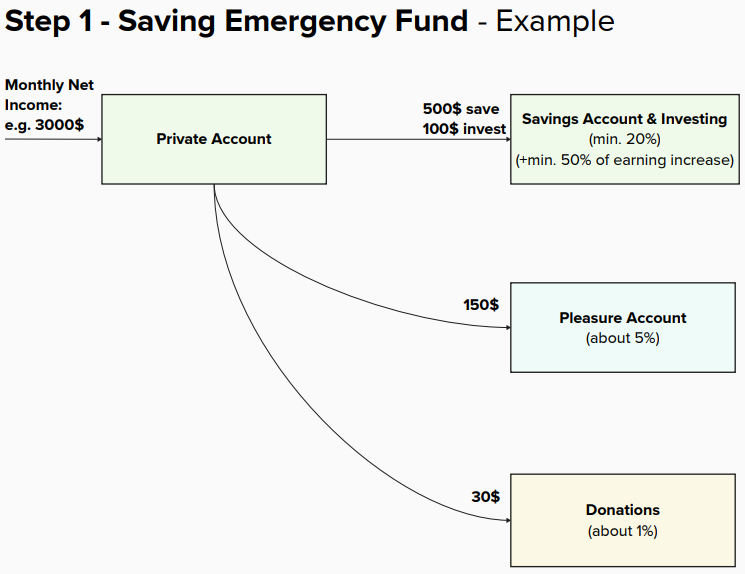
If you are starting from zero, the path to six months of expenses may feel long. The practical approach is to start building the emergency fund and begin investing a small amount simultaneously, even if that initial investment is only $10 or $20 per month. Getting into the market early, even at a tiny scale, means you start learning how investments behave, building the habit of regular contributions, and benefiting from compound growth from the earliest possible moment.
Pay Yourself First: The Most Important Rule in Personal Finance
Most people manage their money in the wrong order. They receive their income, pay their bills and expenses, spend what remains on day-to-day living, and then, if anything is left over at the end of the month, they think about saving or investing. The problem is that for most people, nothing is left over. The spending expands to fill whatever is available.
The single most effective change you can make to your financial life is to reverse this order. When your income arrives, the very first thing you do is move your savings and investment contribution to a separate account before you pay anything else. You pay yourself first, and then you live on what remains.
This one shift changes everything. Your savings and investments become non-negotiable rather than optional. Your spending naturally adjusts to work within what is left. And because the transfer happens at the start of the month rather than the end, you never have the opportunity to spend the money before you save it.
A good point is 20% of your income directed to savings and investments the moment you are paid. If 20% feels unreachable right now, start with whatever you can manage and increase it gradually. The habit is more important than the amount in the early stages.
A Practical Income Plan You Can Use Right Away
Once you are in the habit of paying yourself first, you can structure your income into a simple plan that covers every financial priority without requiring ongoing willpower or complex decisions.
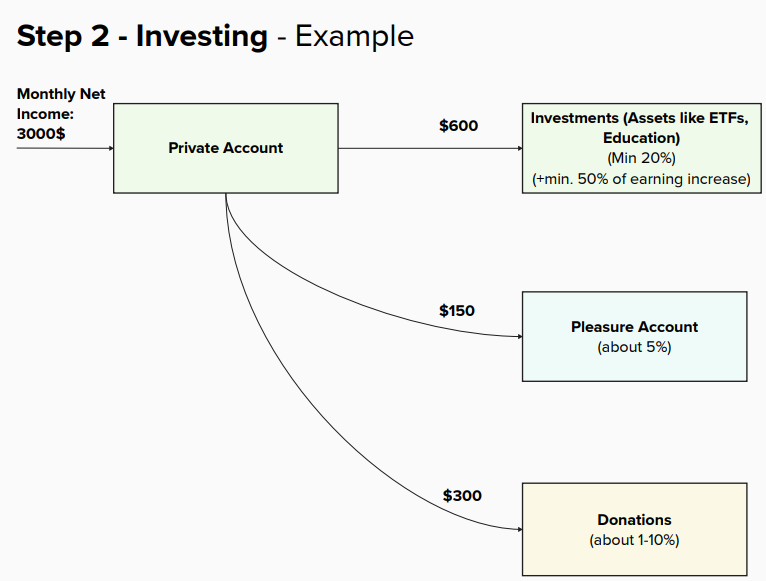
The starting structure looks like this. When your income arrives, direct 20% or more immediately to savings and investments. Within that allocation, prioritise building your emergency fund first if it is not yet fully funded, then shift the full amount to investments once it is. From the remaining 80%, cover your essential expenses such as rent, food, utilities and transport. Set aside a small pleasure account, around 5%, as guilt-free spending on experiences and enjoyment that you do not need to justify or feel anxious about. And finally, include a small donation allocation, even just 1% of your income, for giving back.
That final point deserves its own section.
What to Do Every Time You Get a Pay Rise
Income growth is one of the most powerful levers available for accelerating wealth building, but only if you manage it intentionally. The natural tendency when income rises is for spending to rise in proportion, a pattern sometimes called lifestyle inflation, which means your savings rate stays the same even as your earnings grow.
A more effective approach is to treat every pay rise as an investment opportunity. When your income increases, direct at least 50% of the increase to your investment contributions and allow yourself to enjoy the other 50% through improved quality of life. This way your investments grow significantly faster than they would with a fixed contribution, your lifestyle genuinely improves over time, and you avoid the trap of always spending everything you earn regardless of how much that is.
Aiming to double your income every five years through career progression, skill development and increasing your market value is an ambitious but achievable goal for most people in their 20s and 30s. And every time that income grows, the 50% rule applied consistently to each increase turns career success directly into investment growth.
Why Donating Is Part of a Healthy Financial Life
It might seem counterintuitive to include donating as part of a wealth-building framework, but the evidence from the biographies of many financially successful people suggests it belongs there. From Rockefeller, whose philanthropic commitments began early in his career long before his wealth was established, to countless modern entrepreneurs and investors, a consistent pattern emerges of generosity running alongside financial success rather than against it.
The practical case for including donations in your money management system is partly psychological. Making a deliberate decision to give, even a small amount, trains a particular relationship with money: one of abundance rather than scarcity, of agency rather than anxiety. It also prevents the hoarding mentality that can paradoxically make wealthy people miserable and financially paralysed by the fear of losing what they have accumulated.
Starting with 1% of your income is enough. On a monthly income of $2,500, that is $25. The amount is almost irrelevant. What matters is building the habit early, because the people who say they will start donating once they are rich generally do not. Generosity, like investing, is a muscle that grows with practice.
Key Takeaways
Effective money management comes down to a small number of principles applied consistently over a long time. Track your expenses so you know exactly where your money is going. Cut spending that does not add genuine value to your life. Build a six-month emergency fund before investing heavily. Pay yourself first by directing savings and investments before you spend anything else. Structure your income into clear allocations covering investments, essentials, pleasure and giving. Apply at least 50% of every pay rise to your investment contributions. And start donating early, not because it will directly make you rich, but because it builds the relationship with money that tends to characterise people who become and remain financially successful.
None of this requires a high income, a financial degree or sophisticated tools. It requires a decision to start, and the patience to stay consistent.
Frequently Asked Questions
How much should I be saving each month? A minimum of 20% of your take-home income is good starting point. If that is not currently possible, start with whatever you can manage and increase gradually. The habit matters more than the amount early on.
Should I pay off debt before I start investing? High-interest debt such as credit cards should generally be cleared before directing significant money to investments, because the interest cost of carrying that debt will likely exceed any investment return. Low-interest debt such as student loans or mortgages can typically coexist with a regular investment habit.
How do I build an emergency fund if I am living paycheck to paycheck? Start very small. Even $20 or $50 per month directed to a separate savings account builds the habit and the balance over time. Look for one or two spending categories you can reduce immediately and redirect that amount. The balance grows faster than most people expect once the habit is established.
What is the best account to keep my emergency fund in? A high-interest savings account that you can access quickly but that is not linked to your everyday spending account. The slight friction of it being separate reduces the temptation to dip into it for non-emergencies.
When should I move from Step One to Step Two and start investing more heavily? Once your emergency fund covers six months of living expenses, redirect the full 20% or more of your income to investments rather than splitting it between saving and investing.