What is an ETF? What Does ETF Actually Stand For?
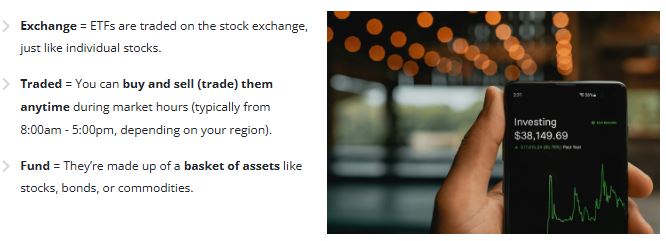
The name exchange-traded fund breaks down into three parts. Each part explains exactly what the product is and how it works.
Exchange: ETFs trade on a stock exchange, just like individual company shares. You buy and sell them through a standard brokerage account during market hours, typically between 8am and 5pm depending on your region. In Australia, ETFs list on the ASX. In Europe, brokers like Interactive Brokers and Trade Republic give you access to exchanges across major financial centres. In the US, ETFs trade on exchanges including the NYSE and NASDAQ, accessible through brokers like Fidelity, Charles Schwab and Interactive Brokers.
Traded: Unlike older investment products such as managed funds, which process orders once at the end of each trading day, you can buy and sell ETFs at any point during market hours at the current price. This makes them highly liquid and easy to access.
Fund: A fund is a pooled investment vehicle — a collection of many different assets bundled together. When you buy one unit of an ETF, you buy a tiny slice of every asset that fund holds. Those assets might be company shares, government bonds, commodities like gold, or a mix of different types.
Put those three parts together and you get a product that trades like a stock, diversifies like a managed fund, and suits any investor with a standard brokerage account and even a modest amount of money.
How Does an Exchange Traded Fund Work? Fruit Basket Analogy
The easiest way to understand an ETF is to think about buying fruit at a market.
One apple vs a whole basket
When you buy a single stock, you buy one apple. You commit your money to one specific thing. If that thing turns out to be bad, you lose out. When you buy an ETF, you buy an entire basket of fruit — an apple, a banana, a kiwi, an orange and a dozen other varieties all at once.
If one piece of fruit turns out to be off, it barely matters. The rest of your basket is fine. The overall value of what you bought is only marginally affected. That is the power of diversification, and it is the core reason ETFs reduce risk so effectively for ordinary investors.
How ETFs track an index
Most broad-market ETFs track an index — a list of companies meeting certain criteria. The S&P 500, for example, is an index of the 500 largest companies listed in the United States. An S&P 500 ETF holds shares in all 500 of those companies at once. When you buy one unit, you own a tiny piece of Apple, Microsoft, Amazon, Tesla and 496 other major companies simultaneously.
If one of those companies has a terrible year or goes bankrupt, your investment barely flinches. The other 499 companies are still working for you.
Over the past 20 years, the S&P 500 delivered an average annualised return of approximately 11.8% per year. You did not need to identify any individual winners. You simply needed to own the whole basket and let the overall growth of the US economy do the work.
Why Are ETFs So Good for Beginner Investors?
ETFs suit beginner investors for four reasons that work together to make them uniquely accessible.
Diversification is built in
The moment you buy an ETF, your money spreads across dozens, hundreds or thousands of different companies. You do not need to research individual businesses, understand balance sheets or predict which industries will perform well. Diversification is automatic and immediate. It dramatically reduces the risk of one bad investment damaging your portfolio.
Fees are very low
Most ETFs passively track an index rather than employing analysts to pick investments. This keeps costs very low. Annual fees for broad-market ETFs typically range from 0.05% to 0.50% per year. A fee of 0.20% on a $10,000 investment costs you $20 per year. Actively managed funds often charge 1% or more. Research consistently shows they rarely justify the extra cost with better performance. With ETFs, more of your money stays invested and keeps compounding.
The system is simple
There is no need to watch markets daily, read financial news obsessively or make complex timing decisions. You choose a broadly diversified ETF, set up a regular monthly contribution through your broker, and let compound interest and long-term market growth do the heavy lifting. Once set up, the time commitment is minimal.
Anyone can start
You can buy most ETFs for as little as $10 to $25 per unit. There is no large minimum investment, no complex application process and no requirement to be a sophisticated investor. If you have a brokerage account, you can buy an ETF in seconds, exactly the same way you would buy a single stock.
What Types of ETFs Exist?
While broad-market index ETFs are the most suitable starting point for most beginners, it is useful to understand the full landscape of ETF types so you can make informed decisions as your investing knowledge grows.
Equity ETFs track a basket of company shares, usually following a major stock market index. The S&P 500 ETF is the most well-known example, but equity ETFs also exist for European markets, Asian markets, emerging markets, and global indices that cover companies across dozens of countries simultaneously. These are the core building block of most beginner ETF portfolios.
Bond ETFs hold government or corporate bonds rather than company shares. A bond is essentially a loan you make to a government or company in exchange for regular interest payments. Bond ETFs collect those interest payments and pass them on to investors. They tend to offer lower returns than equity ETFs, typically around 3 to 4% per year, but they are considerably more stable and serve as a useful cushion in a diversified portfolio during periods of stock market volatility.
Commodity ETFs track physical raw materials like gold, silver or oil. These can provide a hedge against inflation or stock market downturns, though they behave quite differently from equity or bond ETFs and are generally less suitable as a primary investment for beginners.
Thematic and sustainable ETFs are built around specific investment themes or ethical criteria rather than broad market indices. A clean energy ETF, for example, holds companies involved in renewable energy production. An ESG ETF applies environmental, social and governance screens to exclude companies involved in fossil fuels, tobacco, weapons or other sectors that do not meet defined sustainability standards. For investors who want their portfolio to reflect their values as well as build wealth, sustainable ETFs are an increasingly popular and well-developed option. You can explore ESG and sustainable ETF options for Australian investors on the ASX website and for European investors through justETF. US investors can explore ESG ETF options through fund providers including iShares, Vanguard and State Street, or use the ETF.com screener to filter by ESG criteria.
Actively managed ETFs exist but are worth understanding separately. Unlike passive ETFs that simply track an index, actively managed ETFs employ investment professionals who decide which assets to buy and sell. These carry higher fees and, as discussed in the passive investing guide, approximately 90% of active managers fail to outperform a simple broad-market index over a 10-year period. For most beginner investors, passive ETFs are the more effective and lower-cost choice.
ETFs vs Stocks vs Bonds vs Crypto: A Plain-English Comparison
Individual stocks
Stocks offer high growth potential but also high risk. When you buy a single company’s shares, your entire investment ties to that one company’s performance. If it does well, you do well. If it struggles or goes bankrupt, you lose that money. Stocks also require ongoing research and monitoring. They carry no built-in diversification unless you manually build a large portfolio, which takes significantly more capital and knowledge.
Bonds
Bonds sit at the conservative end of the spectrum. They offer predictable, steady income from government or corporate interest payments. But growth potential is modest, typically 3 to 4% annually. Bonds play an important stabilising role in balanced portfolios but are unlikely to build substantial wealth on their own over long time horizons.
Cryptocurrency
Crypto sits at the opposite extreme. Some cryptocurrencies have generated extraordinary returns at certain points. But they are fundamentally speculative assets. Their value is not tied to company earnings, government revenues or any underlying economic activity. It is driven entirely by what people believe they are worth at any given moment. This makes them extraordinarily volatile. Prices can double or halve in weeks. For beginner investors focused on steady long-term wealth building, cryptocurrency is a high-risk distraction rather than a foundation.
Where ETFs sit
ETFs occupy the sweet spot. They offer meaningful long-term growth through broad market exposure, built-in diversification that reduces single-asset risk, very low fees, and a simplicity that makes them accessible to investors at every experience level.
Which Type of ETF Should a Beginner Start With?
Broad-market passive ETFs
Broadly diversified passive ETFs that track global or major regional indices are the most common starting point for new investors. They provide exposure to long-term world economic growth across hundreds or thousands of companies at once. There is no need to identify individual winners, time the market or pay high management fees.
Thematic and sector-specific ETFs
The appeal of thematic ETFs is understandable. Clean energy, artificial intelligence and semiconductor ETFs focus on sectors many investors find compelling. The trade-off is concentration. A thematic ETF bets on one sector outperforming the broader market. That introduces a level of concentration risk that broad-market ETFs spread across the entire market instead.
The long-term approach
Many experienced investors build a core position in broad-market ETFs first, then consider adding a smaller allocation to thematic or sustainable ETFs once that foundation is in place. This approach keeps the majority of the portfolio diversified while allowing room for values-aligned or sector-specific exposure.
Understanding how each ETF type behaves, in terms of diversification, fees, concentration risk and values alignment, helps you build a portfolio that reflects your own circumstances and goals.
Key Takeaways
An ETF is a basket of assets, usually company shares, that you can buy and sell on a stock exchange like a single stock. It gives you instant diversification, very low fees, and access to the long-term growth of entire markets rather than individual companies. For beginner investors, broad-market passive ETFs are the most effective and least stressful starting point, combining the growth potential of equity markets with the safety of diversification and the accessibility of a product you can buy for as little as $25. To research Australian ETFs, visit the ASX website. For European options, justETF is the most comprehensive free research tool available. US investors can use the ETF.com screener or the fund screener tools available through Fidelity and Charles Schwab.
Frequently Asked Questions
How do I actually buy an ETF?
You buy an ETF through a brokerage account, the same way you would buy a single share. Open an account with a broker that gives you access to the exchange your chosen ETF is listed on, deposit funds, search for the ETF by its ticker code and place a buy order. The whole process takes minutes.
Can I lose all my money in an ETF?
For a broadly diversified ETF tracking hundreds of companies, the risk of total loss is effectively zero because every company in the fund would need to go to zero simultaneously. Individual values fluctuate with market conditions, but broad-market ETFs have always recovered from downturns over long holding periods.
What is an expense ratio and does it matter?
The expense ratio is the annual management fee charged by the fund provider, expressed as a percentage of your investment. A 0.20% expense ratio on a $10,000 portfolio costs $20 per year. It matters over long time horizons because fees compound just as returns do, but for most passive ETFs the fees are low enough that they should not be a primary decision driver.
What is the difference between an accumulating and distributing ETF?
An accumulating ETF automatically reinvests any dividends or income back into the fund, compounding your returns over time. A distributing ETF pays those dividends out to you as cash. For long-term wealth building, accumulating ETFs are generally more tax-efficient and better suited to a passive buy-and-hold strategy.
Are sustainable ETFs as good as regular ETFs?
Sustainable or ESG ETFs apply ethical screens to their holdings but function exactly like conventional passive ETFs in terms of how you buy, hold and sell them. Evidence on their long-term performance relative to conventional ETFs is broadly comparable, with some sustainable ETFs outperforming and others slightly underperforming depending on the time period and market conditions examined.
Prefer to learn by watching? The video below covers everything in this article. The written guide below goes into additional depth on each topic with examples, figures and links to further reading.
What is an ETF? What Does ETF Actually Stand For?
The name exchange-traded fund breaks down into three parts. Each part explains exactly what the product is and how it works.
Exchange: ETFs trade on a stock exchange, just like individual company shares. You buy and sell them through a standard brokerage account during market hours, typically between 8am and 5pm depending on your region. In Australia, ETFs list on the ASX. In Europe, brokers like Interactive Brokers and Trade Republic give you access to exchanges across major financial centres. In the US, ETFs trade on exchanges including the NYSE and NASDAQ, accessible through brokers like Fidelity, Charles Schwab and Interactive Brokers.
Traded: Unlike older investment products such as managed funds, which process orders once at the end of each trading day, you can buy and sell ETFs at any point during market hours at the current price. This makes them highly liquid and easy to access.
Fund: A fund is a pooled investment vehicle — a collection of many different assets bundled together. When you buy one unit of an ETF, you buy a tiny slice of every asset that fund holds. Those assets might be company shares, government bonds, commodities like gold, or a mix of different types.
Put those three parts together and you get a product that trades like a stock, diversifies like a managed fund, and suits any investor with a standard brokerage account and even a modest amount of money.
How Does an Exchange Traded Fund Work? Fruit Basket Analogy
The easiest way to understand an ETF is to think about buying fruit at a market.
One apple vs a whole basket
When you buy a single stock, you buy one apple. You commit your money to one specific thing. If that thing turns out to be bad, you lose out. When you buy an ETF, you buy an entire basket of fruit — an apple, a banana, a kiwi, an orange and a dozen other varieties all at once.
If one piece of fruit turns out to be off, it barely matters. The rest of your basket is fine. The overall value of what you bought is only marginally affected. That is the power of diversification, and it is the core reason ETFs reduce risk so effectively for ordinary investors.
How ETFs track an index
Most broad-market ETFs track an index — a list of companies meeting certain criteria. The S&P 500, for example, is an index of the 500 largest companies listed in the United States. An S&P 500 ETF holds shares in all 500 of those companies at once. When you buy one unit, you own a tiny piece of Apple, Microsoft, Amazon, Tesla and 496 other major companies simultaneously.
If one of those companies has a terrible year or goes bankrupt, your investment barely flinches. The other 499 companies are still working for you.
Over the past 20 years, the S&P 500 delivered an average annualised return of approximately 11.8% per year. You did not need to identify any individual winners. You simply needed to own the whole basket and let the overall growth of the US economy do the work.
Why Are ETFs So Good for Beginner Investors?
ETFs suit beginner investors for four reasons that work together to make them uniquely accessible.
Diversification is built in
The moment you buy an ETF, your money spreads across dozens, hundreds or thousands of different companies. You do not need to research individual businesses, understand balance sheets or predict which industries will perform well. Diversification is automatic and immediate. It dramatically reduces the risk of one bad investment damaging your portfolio.
Fees are very low
Most ETFs passively track an index rather than employing analysts to pick investments. This keeps costs very low. Annual fees for broad-market ETFs typically range from 0.05% to 0.50% per year. A fee of 0.20% on a $10,000 investment costs you $20 per year. Actively managed funds often charge 1% or more. Research consistently shows they rarely justify the extra cost with better performance. With ETFs, more of your money stays invested and keeps compounding.
The system is simple
There is no need to watch markets daily, read financial news obsessively or make complex timing decisions. You choose a broadly diversified ETF, set up a regular monthly contribution through your broker, and let compound interest and long-term market growth do the heavy lifting. Once set up, the time commitment is minimal.
Anyone can start
You can buy most ETFs for as little as $10 to $25 per unit. There is no large minimum investment, no complex application process and no requirement to be a sophisticated investor. If you have a brokerage account, you can buy an ETF in seconds, exactly the same way you would buy a single stock.
What Types of ETFs Exist?
While broad-market index ETFs are the most suitable starting point for most beginners, it is useful to understand the full landscape of ETF types so you can make informed decisions as your investing knowledge grows.
Equity ETFs track a basket of company shares, usually following a major stock market index. The S&P 500 ETF is the most well-known example, but equity ETFs also exist for European markets, Asian markets, emerging markets, and global indices that cover companies across dozens of countries simultaneously. These are the core building block of most beginner ETF portfolios.
Bond ETFs hold government or corporate bonds rather than company shares. A bond is essentially a loan you make to a government or company in exchange for regular interest payments. Bond ETFs collect those interest payments and pass them on to investors. They tend to offer lower returns than equity ETFs, typically around 3 to 4% per year, but they are considerably more stable and serve as a useful cushion in a diversified portfolio during periods of stock market volatility.
Commodity ETFs track physical raw materials like gold, silver or oil. These can provide a hedge against inflation or stock market downturns, though they behave quite differently from equity or bond ETFs and are generally less suitable as a primary investment for beginners.
Thematic and sustainable ETFs are built around specific investment themes or ethical criteria rather than broad market indices. A clean energy ETF, for example, holds companies involved in renewable energy production. An ESG ETF applies environmental, social and governance screens to exclude companies involved in fossil fuels, tobacco, weapons or other sectors that do not meet defined sustainability standards. For investors who want their portfolio to reflect their values as well as build wealth, sustainable ETFs are an increasingly popular and well-developed option. You can explore ESG and sustainable ETF options for Australian investors on the ASX website and for European investors through justETF. US investors can explore ESG ETF options through fund providers including iShares, Vanguard and State Street, or use the ETF.com screener to filter by ESG criteria.
Actively managed ETFs exist but are worth understanding separately. Unlike passive ETFs that simply track an index, actively managed ETFs employ investment professionals who decide which assets to buy and sell. These carry higher fees and, as discussed in the passive investing guide, approximately 90% of active managers fail to outperform a simple broad-market index over a 10-year period. For most beginner investors, passive ETFs are the more effective and lower-cost choice.
ETFs vs Stocks vs Bonds vs Crypto: A Plain-English Comparison
Individual stocks
Stocks offer high growth potential but also high risk. When you buy a single company’s shares, your entire investment ties to that one company’s performance. If it does well, you do well. If it struggles or goes bankrupt, you lose that money. Stocks also require ongoing research and monitoring. They carry no built-in diversification unless you manually build a large portfolio, which takes significantly more capital and knowledge.
Bonds
Bonds sit at the conservative end of the spectrum. They offer predictable, steady income from government or corporate interest payments. But growth potential is modest, typically 3 to 4% annually. Bonds play an important stabilising role in balanced portfolios but are unlikely to build substantial wealth on their own over long time horizons.
Cryptocurrency
Crypto sits at the opposite extreme. Some cryptocurrencies have generated extraordinary returns at certain points. But they are fundamentally speculative assets. Their value is not tied to company earnings, government revenues or any underlying economic activity. It is driven entirely by what people believe they are worth at any given moment. This makes them extraordinarily volatile. Prices can double or halve in weeks. For beginner investors focused on steady long-term wealth building, cryptocurrency is a high-risk distraction rather than a foundation.
Where ETFs sit
ETFs occupy the sweet spot. They offer meaningful long-term growth through broad market exposure, built-in diversification that reduces single-asset risk, very low fees, and a simplicity that makes them accessible to investors at every experience level.
Which Type of ETF Should a Beginner Start With?
Broad-market passive ETFs
Broadly diversified passive ETFs that track global or major regional indices are the most common starting point for new investors. They provide exposure to long-term world economic growth across hundreds or thousands of companies at once. There is no need to identify individual winners, time the market or pay high management fees.
Thematic and sector-specific ETFs
The appeal of thematic ETFs is understandable. Clean energy, artificial intelligence and semiconductor ETFs focus on sectors many investors find compelling. The trade-off is concentration. A thematic ETF bets on one sector outperforming the broader market. That introduces a level of concentration risk that broad-market ETFs spread across the entire market instead.
The long-term approach
Many experienced investors build a core position in broad-market ETFs first, then consider adding a smaller allocation to thematic or sustainable ETFs once that foundation is in place. This approach keeps the majority of the portfolio diversified while allowing room for values-aligned or sector-specific exposure.
Understanding how each ETF type behaves, in terms of diversification, fees, concentration risk and values alignment, helps you build a portfolio that reflects your own circumstances and goals.
Key Takeaways
An ETF is a basket of assets, usually company shares, that you can buy and sell on a stock exchange like a single stock. It gives you instant diversification, very low fees, and access to the long-term growth of entire markets rather than individual companies. For beginner investors, broad-market passive ETFs are the most effective and least stressful starting point, combining the growth potential of equity markets with the safety of diversification and the accessibility of a product you can buy for as little as $25. To research Australian ETFs, visit the ASX website. For European options, justETF is the most comprehensive free research tool available. US investors can use the ETF.com screener or the fund screener tools available through Fidelity and Charles Schwab.
Frequently Asked Questions
How do I actually buy an ETF?
You buy an ETF through a brokerage account, the same way you would buy a single share. Open an account with a broker that gives you access to the exchange your chosen ETF is listed on, deposit funds, search for the ETF by its ticker code and place a buy order. The whole process takes minutes.
Can I lose all my money in an ETF?
For a broadly diversified ETF tracking hundreds of companies, the risk of total loss is effectively zero because every company in the fund would need to go to zero simultaneously. Individual values fluctuate with market conditions, but broad-market ETFs have always recovered from downturns over long holding periods.
What is an expense ratio and does it matter?
The expense ratio is the annual management fee charged by the fund provider, expressed as a percentage of your investment. A 0.20% expense ratio on a $10,000 portfolio costs $20 per year. It matters over long time horizons because fees compound just as returns do, but for most passive ETFs the fees are low enough that they should not be a primary decision driver.
What is the difference between an accumulating and distributing ETF?
An accumulating ETF automatically reinvests any dividends or income back into the fund, compounding your returns over time. A distributing ETF pays those dividends out to you as cash. For long-term wealth building, accumulating ETFs are generally more tax-efficient and better suited to a passive buy-and-hold strategy.
Are sustainable ETFs as good as regular ETFs?
Sustainable or ESG ETFs apply ethical screens to their holdings but function exactly like conventional passive ETFs in terms of how you buy, hold and sell them. Evidence on their long-term performance relative to conventional ETFs is broadly comparable, with some sustainable ETFs outperforming and others slightly underperforming depending on the time period and market conditions examined.